No. of students who attempted this question- 23,468
Source: Ei ASSET Class 5 Correct Answer: C Skill Tested: Hypothesis formulation or prediction of outcome
What is the Question Testing?
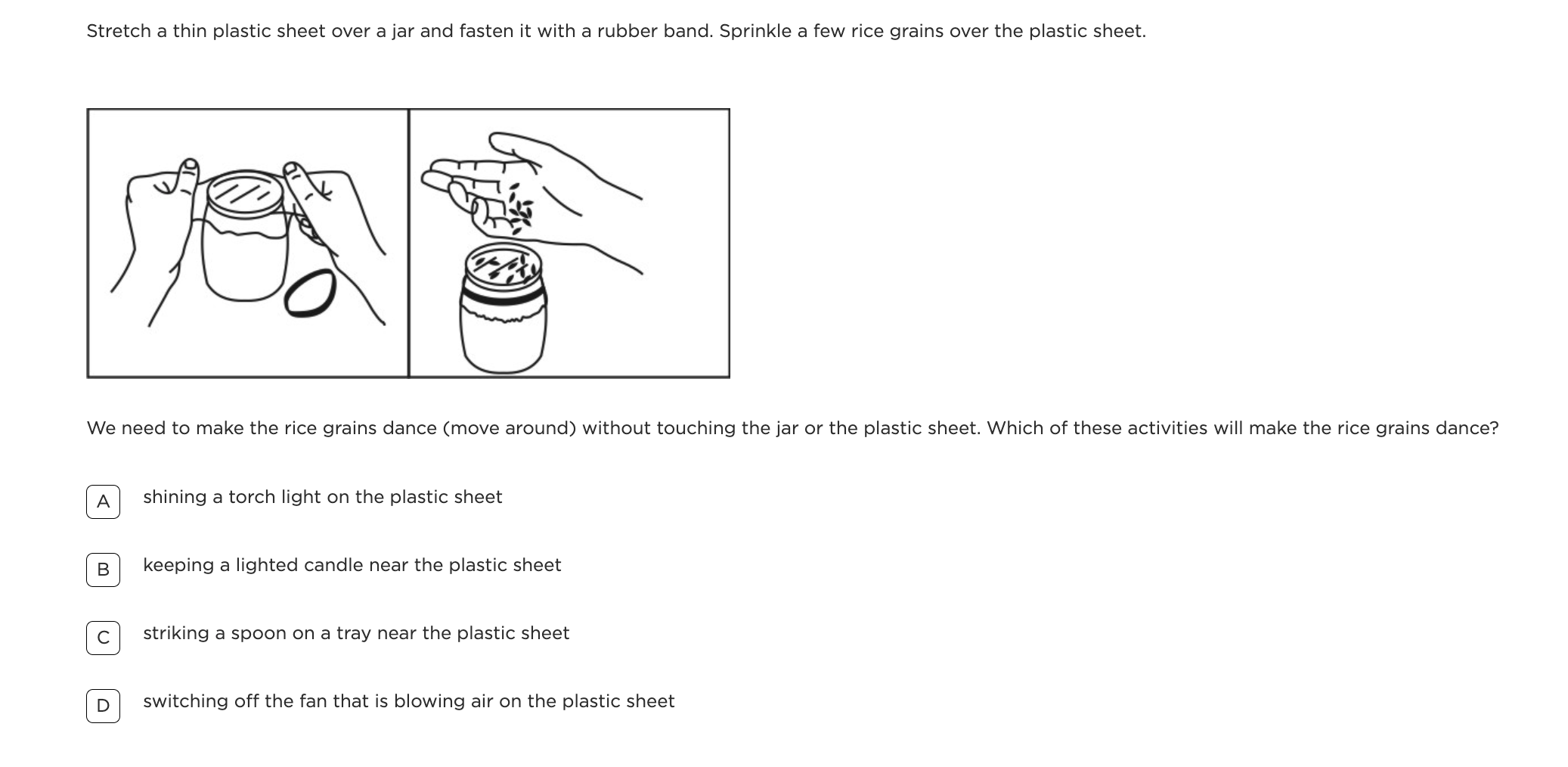
This question assesses students’ conceptual understanding of sound as vibration and how sound energy travels through a medium to produce visible movement. It checks whether students can apply their understanding of sound beyond hearing, recognising that sound waves create vibrations that can cause objects to move.
The task also examines students’ ability to connect an experimental setup with scientific reasoning. Students must interpret the situation and predict which external action can transfer energy to the plastic sheet without physical contact. This involves linking theoretical knowledge about sound with practical observation and inference.
Distractor Explanation :
Option A: Shining a torch light on the plastic sheet Error Type: Confusion between light energy and mechanical vibration Reasoning: Students may assume that any form of energy or external stimulus can cause movement. This indicates an incomplete understanding that light transfers energy differently and does not typically produce the vibrations required to move rice grains.
Option B: Keeping a lighted candle near the plastic sheet Error Type: Misconception about heat and movement Reasoning: Students may believe that heat or flame produces sufficient force to move the grains. This suggests limited clarity about how heat energy differs from sound vibrations and about the conditions required for observable movement.
Option D: Switching off the fan that is blowing air on the plastic sheet Error Type: Difficulty visualising cause and effect in the experiment Reasoning: Students choosing this option may recognise that air movement affects objects but fail to understand that stopping airflow would reduce, rather than create, movement. This reflects challenges in reasoning about experimental conditions and predicting outcomes.
What Will Happen if Children Do Not Develop This Concept Adequately?
Weak Conceptual Understanding of Sound: Students may associate sound only with hearing rather than recognising it as vibration and energy transfer.
Limited Scientific Observation Skills: They may struggle to interpret demonstrations where sound produces physical effects, such as vibration in musical instruments or resonance experiments.
Challenges in Advanced Topics: Misunderstanding vibration and wave behaviour can affect learning in later topics such as sound transmission, properties of waves, and even earthquake or electromagnetic wave concepts.
Difficulty Linking Theory with Experiments: Students may memorise definitions of sound but fail to apply them to real-world or laboratory situations.
How Should I Remediate This in My Class?
Concrete Demonstrations
Conduct simple experiments such as placing rice grains or small paper pieces on a drum or stretched balloon and producing sound near it.
Encourage students to observe and describe what changes when sound intensity or distance varies.
Link Sound with Everyday Experiences
Use examples such as feeling vibrations when touching a speaker, musical instrument strings, or mobile phones on vibration mode.
Ask students to identify situations where sound causes movement in daily life.
Explicit Teaching of Energy Transfer
Reinforce that sound travels through vibrations in a medium and transfers energy that can move objects.
Use diagrams or slow-motion videos to illustrate how sound waves create movement.
Predict–Observe–Explain Strategy
Before performing demonstrations, ask students to predict outcomes.
After observation, discuss differences between predictions and results to build conceptual clarity.
Analyse Distractors as Learning Opportunities
Present incorrect options and ask students to explain why they would or would not work.
Encourage scientific reasoning rather than simple answer selection.
Strengthening students’ understanding of sound as vibration helps them connect scientific theory with observable phenomena and supports deeper learning in physics and everyday scientific reasoning.