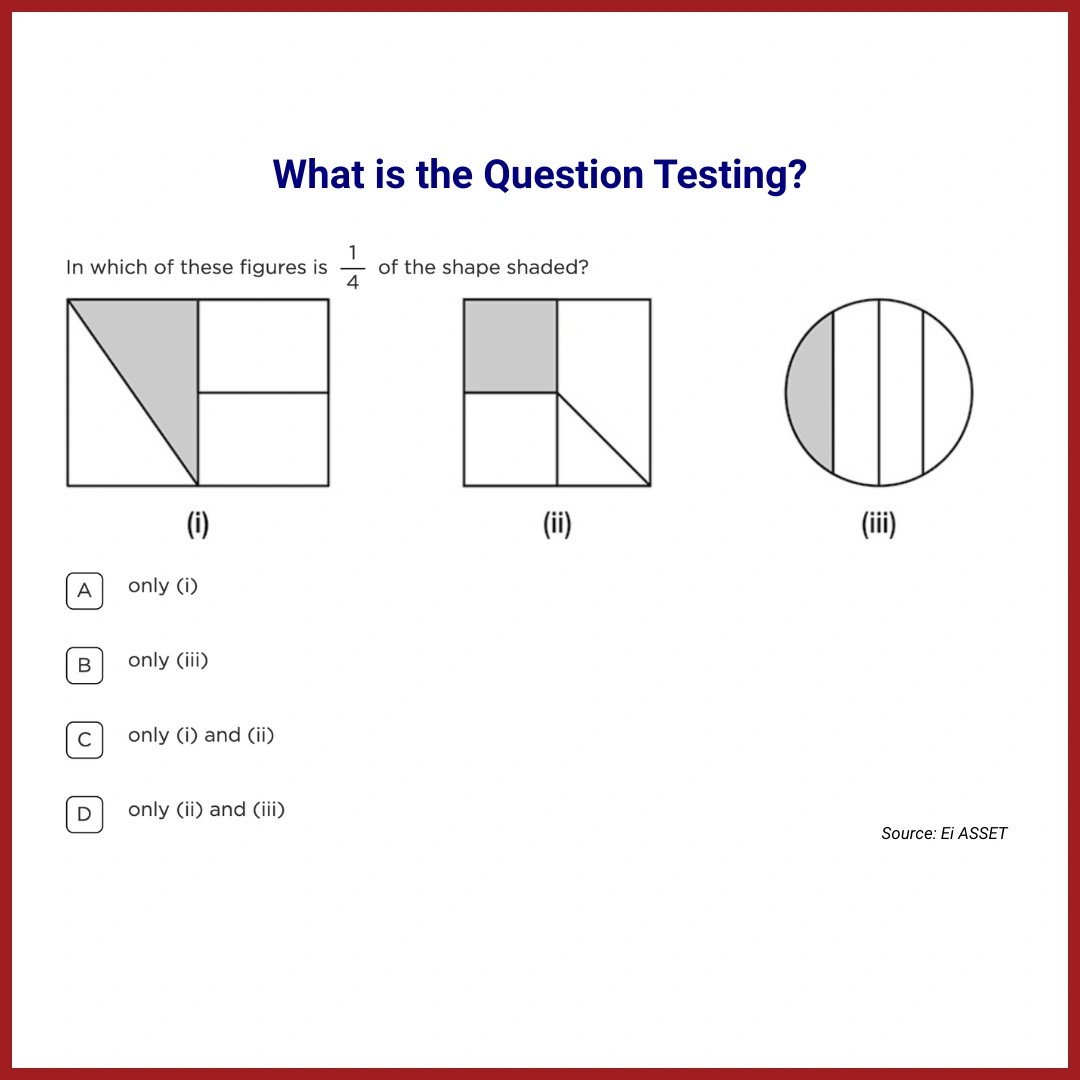
Source: Ei ASSET Class 6 Correct Answer: D Skill Tested: Number sense, related concepts and basic number competency
Most Common Wrong Answer: B
What is the Question Testing?
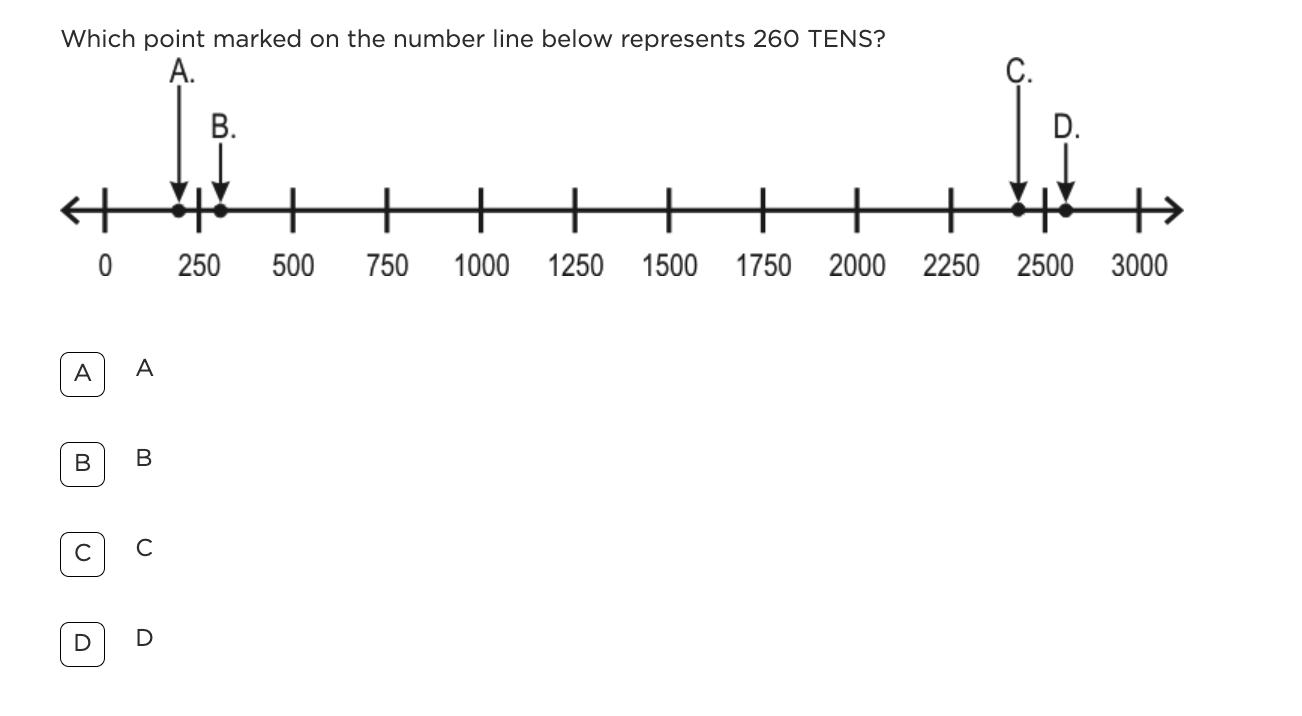
This question assesses a student’s foundational understanding of place value and its application within a larger number system. It specifically tests the ability to convert a quantity expressed in tens into its standard numerical form-in this case, realising that 260 tens is equivalent to 2600. Furthermore, it checks if students can accurately locate this converted value on a scaled number line, requiring both conceptual place value knowledge and spatial estimation skills.
What is the Most Common Wrong Answer and Possible Misconception?
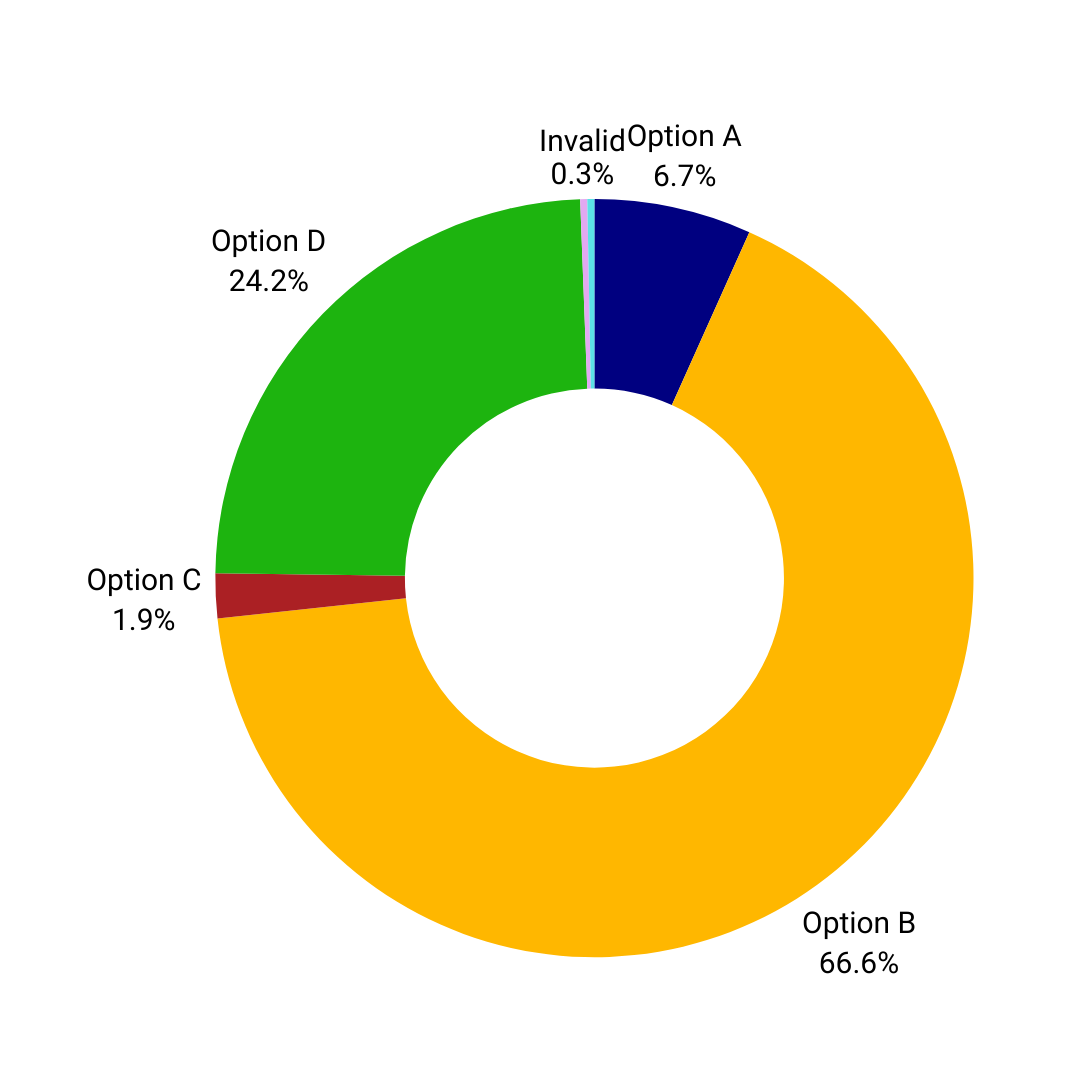
Most Common Wrong Answer: Option B (66.6%)
Distractor Explanation :
Option B (260):
Error Type: Literal interpretation and place value neglect.
Reasoning: An overwhelming majority of students (nearly 67%) simply saw the digits 260 in the question and looked for the point marked 260 on the number line. They failed to process the word TENS as a multiplier. For these students, the label of the unit was invisible; they treated 260 tens as 260 ones.
Option A (240):
Error Type: Spatial misinterpretation or estimation error.
Reasoning: A smaller group of students (6.7%) likely followed the same literal logic as those who chose Option B but misread the scale of the number line. They chose 240, possibly confusing the markings or lacking the number line fluency to distinguish between 240 and 260.
What Will Happen if Children Do Not Develop This Concept Adequately?
Impact on Understanding of Large Numbers: If students do not move beyond a literal reading of digits, they will struggle with the base-ten nature of our number system. Failing to recognise that 10 tens make a hundred or that 260 tens make 26 hundreds (2600) prevents them from visualising and comparing larger magnitudes accurately.
Further Implications: This confusion leads to significant hurdles in mental math and the standard algorithms for multiplication and division. Without a firm grasp of place value units, students often make errors when regrouping or carrying over, as they do not truly understand the value of the numbers they are manipulating. It turns mathematics into a series of memorised steps rather than a logical system of values.
How Should I Remediate This in My Class?
Use Concrete and Visual Aids:
Demonstrate the scale of units using base-ten blocks. Physically show that stacking 10 tens creates a hundred-block to reinforce the conversion.
Use an abacus to show how 10 beads on the tens wire are equivalent to 1 bead on the hundreds wire.
Bridge the Language Gap:
Practice oral conversions. Ask students questions like: How many tens are in 100? or What is 15 tens?
Use place value charts to write out 260 in the tens column and then show how the digits shift to the left when converted to standard form (2600).
Reinforce the Number Line Logic:
Create number lines with different scales. Ask students to mark 26 tens on a number line that goes from 0 to 500, forcing them to convert to 260 first.
Ask students to explain why Option B is 260 ones and not 260 tens to help them verbalize the difference between the face value and the place value.
Error Analysis:
For teachers- Show the national performance data to your fellow teachers. Ask them why they think so many students across the country chose Option B. This will have impact on other teachers approach the topic and preempt student errors.
For students- Use journaling prompts: Explain the steps you take to find 260 TENS on a number line. This encourages students to verbalise the conversion step before the locating step.
By shifting the focus from simply reading digits to understanding the units those digits represent, students build the conceptual strength needed for more advanced arithmetic.