Source: Ei ASSET Class 9
Correct Answer: D
Skill Tested: Knowledge of use of scientific instruments, tools and procedures- Scientific Literacy
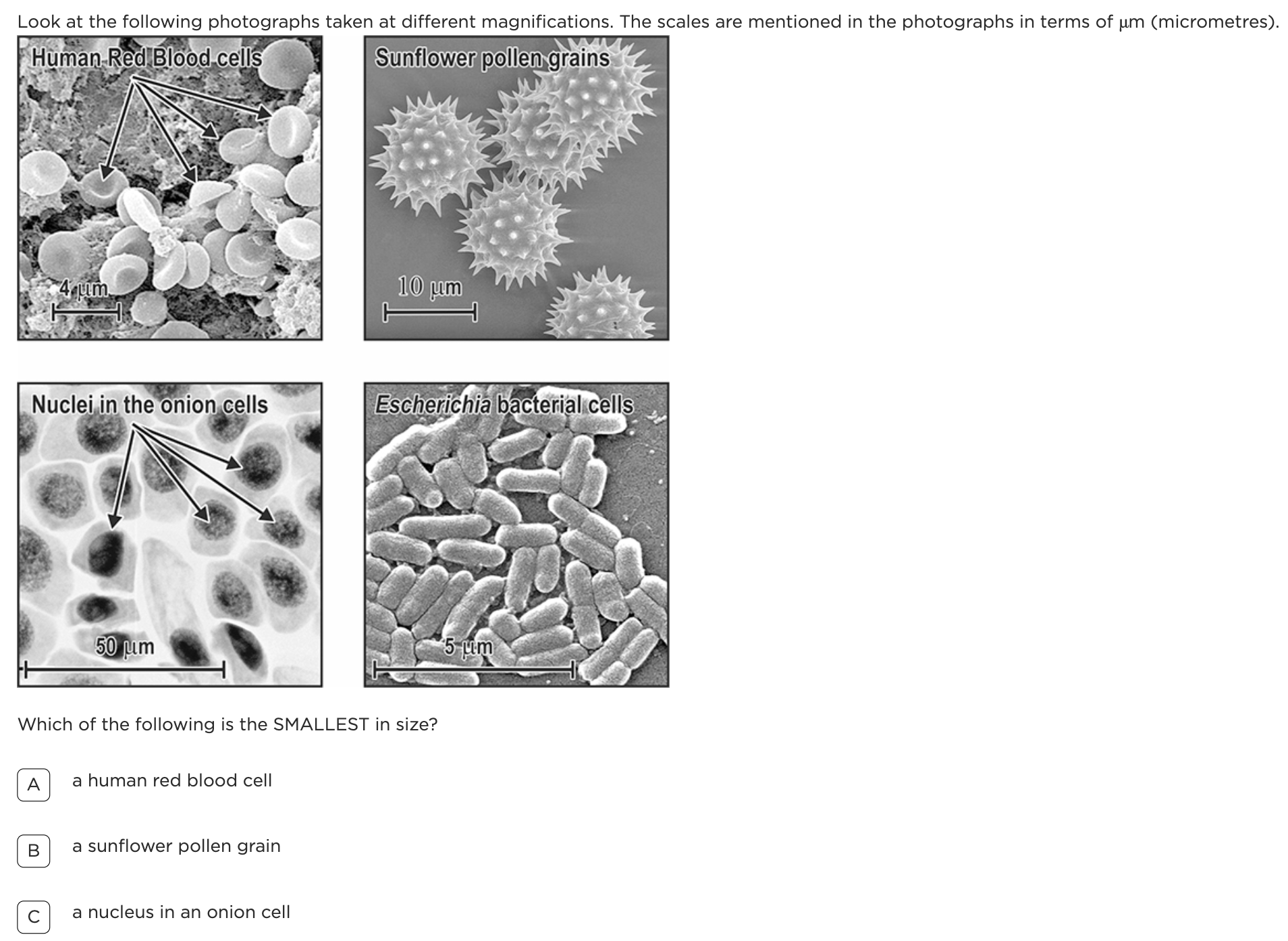
This question assesses students’ ability to interpret scale bars in microscopic images and compare the relative sizes of different biological structures. Students must understand that magnification varies across images and should use the given scales—not visual appearance—to identify the smallest structure.
Most Common Wrong Answer: Option A (human red blood cell)
Many students rely on the apparent size in the picture rather than reading the scale bars provided.

Learners who selected Options A, B, or C often assume that the object that looks smallest in the photograph is indeed the smallest, missing that different images use different magnifications.
The most common error reflects a misconception called ‘visual size bias’– students judge size based on the picture rather than proportional measurement using the micrometre scale.
Students may misjudge scientific diagrams, micrographs, and data representations that rely on accurate reading of scales.
They may assume incorrect relationships between cells, organelles, and microorganisms, affecting future learning in microbiology and cell biology.
Failure to use scale bars reduces their ability to analyse scientific images critically, a skill essential for upper-grade biology, physics, and geography.
Demonstrate how the same object can look large or small depending on magnification. Model using the scale bar to determine real size.
Give students multiple micrographs with different scales and ask them to compare the sizes of structures systematically.
Show pairs of images where a larger-looking object is actually smaller when scaled correctly, explaining why visual appearance alone is misleading.
Have students measure lengths on images and convert using the scale bar. This builds confidence in applying ratios and proportional thinking.
This question highlights a common gap in students’ ability to interpret scale bars and compare microscopic structures. Mastery of this skill strengthens scientific reasoning, supports accurate interpretation of biological diagrams, and prevents long-term misconceptions about cell sizes. Teachers should integrate regular practice with scaled images, prompting learners to rely on measurement rather than visual cues.
powered by Advanced iFrame