Ei Study

EI color

Learning
Pulse

Edition 16 | April 2026

Feature Article

The Triangle That Wasn’t

How geometry misconceptions take root — and what teachers can do about them

“Show me a triangle,” the teacher said. Eighteen hands shot up. Every single drawing looked the same — equilateral, flat base, perfectly symmetrical. When she placed a scalene triangle on the board, tilted on one side, a student in the front row frowned and said: “But Miss, that’s not a proper triangle.” 

This small exchange contains a large truth about how children learn geometry. That student was not wrong to be puzzled — she had learned triangles from years of exposure to a single prototype. Her mental model was consistent, internally logical, and entirely incorrect as a generalisation. And she is far from alone.

Analysis of student response data from Mindspark — Educational Initiatives’ adaptive maths platform — and from the Wipro–Ei Quality Education Study, which tested over 23,000 students across Classes 4, 6 and 8 in 89 schools, reveals that geometry is home to some of the most persistent and consequential misconceptions in K–12 mathematics. Unlike computational errors, which are often isolated and correctable with practice, geometry misconceptions tend to be structural: they reflect how a child has built their understanding of space, shape, and measurement — and they resist correction unless the underlying mental model itself is challenged.

Why Geometry Misconceptions Are Different

Most mathematics errors are procedural: a child misremembers a rule, skips a step, or makes an arithmetic slip. These are relatively straightforward to address — identify the gap, reteach the procedure, practise.

Geometry misconceptions operate differently. They are formed through perception and experience — through the shapes children see in textbooks, on worksheets, and in classroom displays. When every triangle a child encounters has a flat horizontal base and equal-ish sides, the mind does what minds are designed to do: it extracts a prototype. That prototype then becomes the definition, even if no one ever said so.

This is not a failure of intelligence. It is prototype theory in action — a well-documented feature of human cognition. The problem arises when instruction never presents the non-canonical case, never stretches the prototype, never asks: what makes this a triangle — not what it looks like, but what makes it one?

Four Geometry Misconceptions the Data Keeps Finding

The evidence below comes from two sources: the Wipro–Ei Quality Education Study (QES), which presents verbatim questions tested with 23,000+ students across Classes 4, 6 and 8, and Mindspark’s FY 2026–27 baseline and endline data, which shows whether the same patterns persist in today’s classrooms. The alignment between the two is striking — the same errors, a decade apart.

A  —  Shape Identity Changes with Orientation

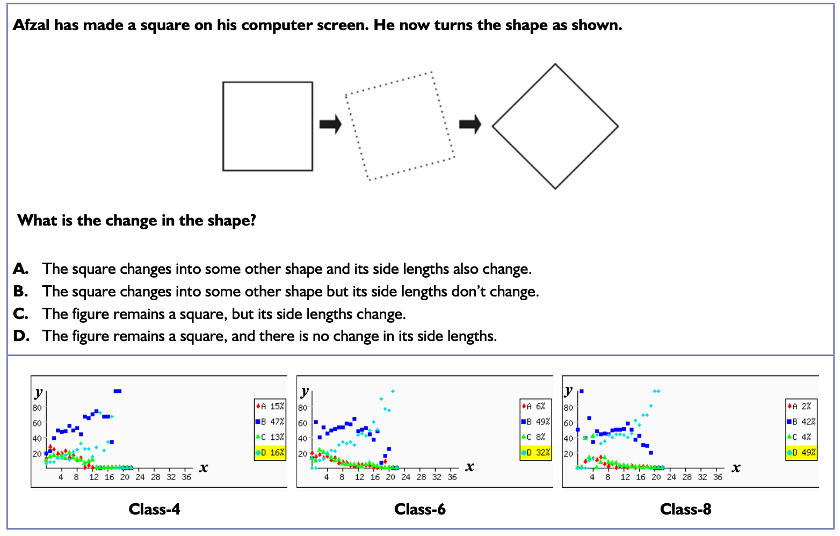
Ask a group of Grade 4 or 5 students whether a square rotated 45 degrees is still a square. A striking proportion will say no — it has become a ‘diamond.’ The same effect occurs with triangles on their sides, rectangles stood vertically, and trapezoids flipped. The shape is reidentified based on its orientation relative to the horizontal, not its defining properties.

This misconception matters because orientation-dependence is precisely what geometry asks students to transcend. Area formulae, congruence tests, and coordinate geometry all require the ability to reason about shapes independent of how they are positioned. A student who can only recognise a rectangle when it sits flat will struggle with every geometry concept that follows.

From the Wipro–Ei Quality Education Study  Class 6  (also tested in Classes 4 & 8)  ·  Shape recognition — orientation

Wipro–Ei QES data  ·  Class 6, Q27 (Paper 612)
About 70% of Class 6 students failed to recognise the rotated square as still a square
47% chose option B — believing the shape changed identity but not size
The same question tested in Classes 4, 6 and 8: wrong answer rate did not decrease meaningfully across grades
Mindspark 2026–27: endline accuracy on shape orientation tasks — 21%–32.8%, gain only 11%


Classroom practice  Create a ‘Shape Rotation Gallery’ on the classroom wall — the same shape displayed at 0°, 45°, 90°, and 135°. Ask students to name each card before revealing that they are identical. The visual confrontation is far more powerful than a verbal explanation. Use physical cut-outs so students can rotate them in their own hands.


B  —  Irregular Shapes Have No Area or Perimeter

In most curricula, the journey into measurement begins well in Grade 3 — with informal measurement of both regular and irregular shapes, using tiles, grids, and counting strategies. At this stage, area is understood intuitively: it is the space a shape covers, regardless of what the shape looks like. Perimeter is the distance around any closed boundary. The concept, at this point, is shape-agnostic.

Then the formulae arrive. Length × breadth for area. 2(l + b) for perimeter. And quietly, something shifts — the concept gets displaced by the procedure.

By the time students reach Grade 6, when they are asked to find the area or perimeter of an L-shaped figure, a hexagon, or any composite or non-standard shape, a common response is hesitation followed by the declaration that it cannot be done. The formula they know applies to rectangles. Anything that does not fit that template is, in the child’s mental model, outside the domain of measurement altogether.

This raises an uncomfortable question: is this a gap in understanding, or a consequence of how mathematics has been taught? When procedures are emphasised over concepts — when students are rewarded for applying the right formula rather than for reasoning about what is being measured — the formula becomes the definition. Area is no longer ‘the amount of surface enclosed.’ It is ‘length times breadth.’ And a shape for which that formula cannot be directly applied is, by the student’s logic, a shape without area.

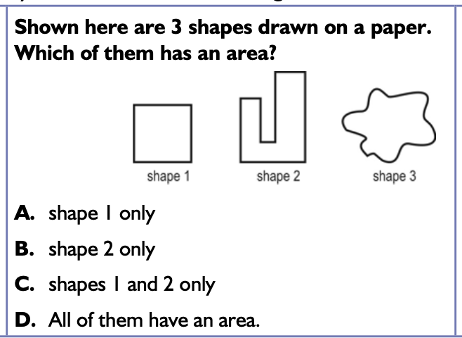
From the Wipro–Ei Quality Education Study  Class 6  ·  Area — irregular and curved shapes

A. Shape 1 only  [19% chose this — only rectangles seen as having area]
B. Shape 2 only
C. Shapes 1 and 2 only  [31% chose this — curved shapes seen as having no area]
D. All of them have an area.  [correct — only 34% of Class 6 students]

Wipro–Ei QES data  ·  Class 6, Q40 (Paper 611)
Only 34% of students correctly identified that all closed shapes have an area
31% believed only straight-sided shapes have area — the L-shape was accepted but the curved shape was not
19% thought only the rectangle (Shape 1) had area — formula-driven thinking
Mindspark  FY 2026–27: area of shape in a square grid (Grade 5) — endline 35.2%, gain −4.0% (negative)


Classroom practice  Introduce area as ‘square-counting’ before introducing any formula. Draw an L-shape on centimetre grid paper and ask students to count squares. Then ask: ‘Can we count the squares without counting one by one?’ This bridges intuition to method, and the formula emerges as a shortcut for something already understood — not as an arbitrary rule.


C  —  Area is Not Conserved When a Shape is Rearranged

One of the most enduring and well-documented findings in mathematics education research is that children struggle to recognise the conservation of area. The idea that a quantity of surface remains unchanged when a shape is cut, rearranged, or transformed — without adding or removing any material — does not come naturally to most learners. It has to be built, carefully and deliberately, through experience. When it is not, students carry a fundamental conceptual gap forward through every grade, and it quietly undermines their ability to reason about measurement in any context beyond the most familiar.

The question below, drawn from the Wipro–Ei Quality Education Study, makes this gap visible with striking clarity.

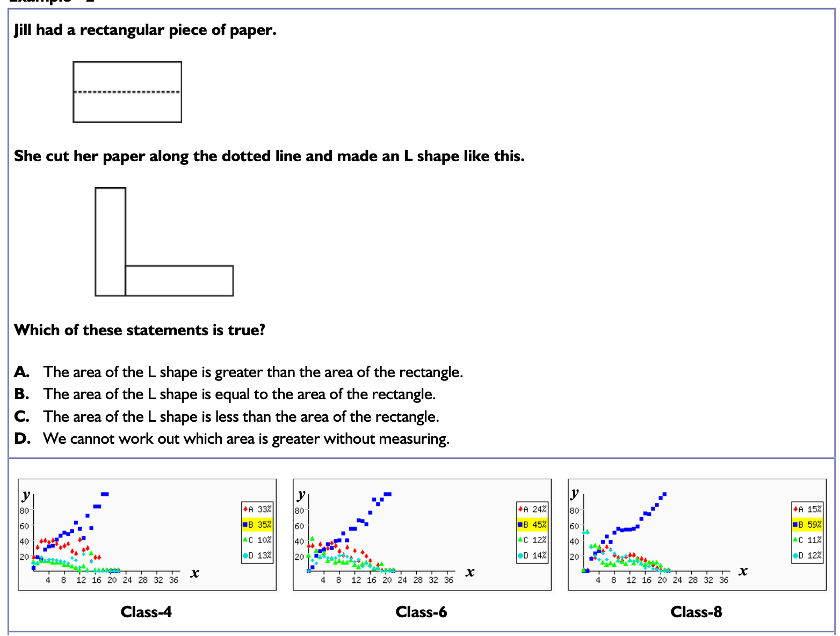
Jill has a rectangular piece of paper. She cuts it along a dotted line and makes an L-shape. Nothing has been added. Nothing has been thrown away. Which of these statements is true — is the area of the L-shape greater than, equal to, or less than the area of the original rectangle?

The correct answer is B: the area is equal. The same surface exists. It has simply been rearranged.

What makes this question particularly revealing is that it was administered to students across Class 4, Class 6, and Class 8 — and the response data tells a story not just about a misconception, but about how stubbornly it persists across years of schooling.

In Class 4, only about 35% of students answered correctly. The most common wrong answer was option A — that the L-shape has a greater area than the rectangle (33%). A further 10% believed the area had decreased. Taken together, nearly two thirds of Class 4 students believed that cutting and rearranging a shape physically changes how much surface it covers.

By Class 6, the picture improves, but only modestly. Correct responses rise to around 45%. The dominant wrong answer shifts — fewer students now say the area increased, but around 12% still believe the L-shape has less area than the rectangle. The visual impression of a shape that looks ‘smaller’ or ‘thinner’ continues to override conceptual reasoning.

By Class 8, 59% of students answer correctly — a meaningful improvement, but one that still leaves roughly 4 in 10 students at secondary level unable to reason correctly about a concept first introduced in primary school. Around 11% still believe the area decreases when the shape is cut and rearranged.

The trajectory is telling. Improvement happens, but it is slow, incomplete, and appears to be driven by accumulated exposure rather than deliberate conceptual teaching. Students are getting better at this question over time — but the data does not suggest they are developing a secure understanding of area conservation. Many are simply becoming more familiar with the question format.

This is a conservation failure — similar in structure to Piagetian conservation of volume. If area were genuinely understood as ‘how much surface is covered’, the question would feel trivial: of course cutting a shape does not change how much paper you have. But when area means ‘the result of length times breadth applied to this shape’, then a shape that has been cut and rearranged is, in the student’s mind, a different shape — and a different shape may well have a different area.

The formula has been memorised. The concept has not been formed. And the graphs across three grade levels show exactly what happens when that gap is never closed.

From the Wipro–Ei Quality Education Study  Classes 4, 6 & 8  ·  Area conservation

A. The area of the L shape is greater than the area of the rectangle.  [common wrong answer in Class 4]
B. The area of the L shape is equal to the area of the rectangle.  [correct]
C. The area of the L shape is less than the area of the rectangle.  [most common wrong answer overall]
D. We cannot work out which area is greater without measuring.

Wipro–Ei QES data  ·  Cross-class study (Classes 4, 6 and 8)
Class 4: only 35% correct  |  Class 6: 45% correct  |  Class 8: 59% correct
Even at Class 8, around 41% of students could not correctly answer this basic area question
The report notes: ‘This is one of the basic understandings in the concept of area’
Mindspark FY 2026–27: area conservation — endline accuracy 24.8%, learning gain only +0.8%



Classroom practice  Use a hands-on conservation task. Give pairs of students 12 square tiles. Ask them to make a rectangle, count the tiles, then rearrange them into a different shape. Ask: ‘Did the number of tiles change? So did the area change?’ The physical act of counting the same tiles twice — in two different arrangements — makes conservation tangible and memorable.


D  —  An Angle’s Size Depends on Its Arm Length

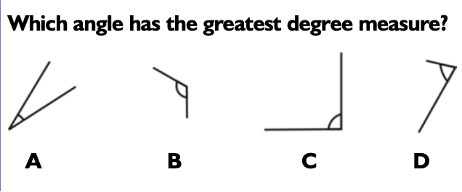
Show students two angles of equal measure — one drawn with short arms, one with long arms — and ask which is bigger. Many will choose the one with longer arms. The visual dominance of length overrides the abstract idea that an angle measures a rotation, not a distance. The same misconception manifests when students equate angle size with the area enclosed between the arms.

This confusion is compounded by the way protractors are typically taught — as tools for reading a number, rather than as instruments for measuring a turn. Students learn to place the protractor and read the scale without understanding what the number means.

From the Wipro–Ei Quality Education Study  Class 6  ·  Angle measurement — arm length misconception

A. Angle A — smallest opening, short arms
B. Angle B — largest degree measure  [correct — only 40% chose this]
C. Angle C — longer arms than B  [35% chose this — longer arms mistaken for bigger angle]
D. Angle D — long arms, small opening

Wipro–Ei QES data  ·  Class 6, Q39 (Paper 611)
Only 40% of Class 6 students correctly identified the angle with the greatest degree measure
35% chose the angle with longer arms — believing arm length determines angle size
The report explains: ‘The measure of an angle as amount of turn is not understood by these students’
Mindspark FY 2026–27: endline accuracy on angle measurement — 37.6% (Grade 5), gain +9.6% — insufficient


Classroom practice  Begin with body angles, not drawn angles. Ask students to turn their body a quarter turn, a half turn, a three-quarter turn. Then model the same turns on paper with a pencil — short arms, then long arms, showing the same rotation. This grounds angle as a measure of turning before any tool is introduced. When the protractor arrives, it is measuring something already understood.


The Curriculum Design Question
Each of these misconceptions has a structural cause rooted not in individual student failure, but in how geometry tends to be taught and presented. Three patterns appear repeatedly:

  1. Formula before concept.  When students memorise ‘length × breadth’ before they understand what area means, the formula becomes an isolated procedure. It works for the shapes it was taught for — and fails everywhere else.

  1. Canonical exposure only.  When triangles, rectangles, and angles appear only in their most typical orientations and forms, children learn prototypes, not definitions. The non-canonical case becomes unrecognisable.

  1. Visual reasoning without conceptual grounding.  When students are not explicitly taught that geometric properties are independent of visual appearance, they default to what they can see — size of arms, orientation, overall shape — and that leads them astray.

The geometry misconceptions that persist across grade levels are not accidents of individual learning — they are predictable consequences of instruction that privileges procedure over understanding.

A Note for School Leaders

Geometry misconceptions are rarely addressed in professional development — they are assumed to be simpler than number concepts, more intuitive, easier to teach. The Wipro–Ei Quality Education Study found the same wrong answers persisting from Class 4 to Class 8 with very little improvement — suggesting that without deliberate intervention, these errors do not self-correct as students progress.
School leaders can make a meaningful difference by including geometry misconception analysis in subject team meetings, by auditing the visual diversity of shapes in classroom materials (do your worksheets show triangles in multiple orientations?), and by creating space for teachers to share and discuss the wrong answers they are seeing — not as problems to solve quickly, but as diagnostic data worth understanding.

Back to That Triangle

The student who said ‘that’s not a proper triangle’ was doing everything right — she was applying what she had learned, consistently and confidently. The gap was not in her reasoning. It was in what she had been given to reason from.

Geometry, perhaps more than any other domain in school mathematics, rewards the teacher who teaches with varied examples, who asks ‘how do you know?’ rather than ‘what is it?’, and who understands that the mind will always build a prototype from what it is shown. Our responsibility is to show it more.

Sources  (1) Wipro–Ei Quality Education Study — Student Misconception and Common Error Report, Educational Initiatives Pvt. Ltd.  (2) Mindspark Ganit baseline and endline student response data, FY 2026–27, compiled by the Ei pedagogy research team.

Ei - Wipro - QUALITY EDUCATION STUDY Student Learning Outcomes

The article is contributed by Jayanti Dasgupta, Vice President – Customer Success (International Business at Ei)

Are these principles already part of your teaching toolkit?
We’d love to hear your story!

Share how you bring these principles to life in your classroom and inspire fellow educators. Write to us at prakhar.ghildyal@ei.study and tell us about your unique teaching journey

Enjoyed the read? Spread the word

Interested in being featured in our newsletter?

Write to us here.

Feature Articles

Join Our Newsletter

Your monthly dose of education insights and innovations delivered to your inbox!

powered by Advanced iFrame