Question Source: Ei ASSET Class: 9
Subject: Mathematics
What is the Question Testing?
This question tests studentsʼ ability to compare fractions where both the numerators and
denominators are different. More specifically, it checks whether students can look beyond the
surface size of the numbers and reason about the actual value of each fraction.
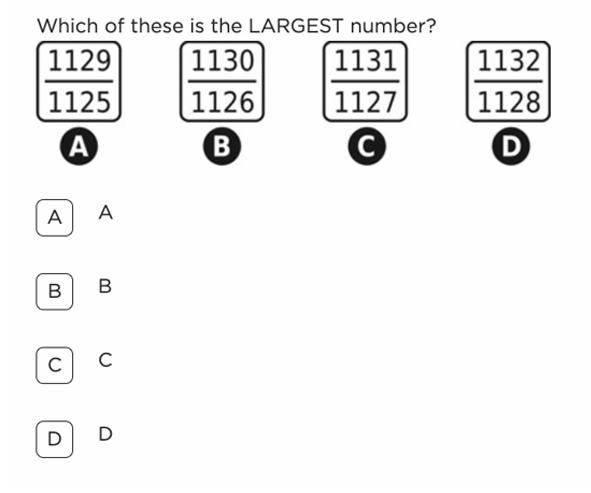
The four fractions are:
1129/1125, 1130/1126, 1131/1127 and 1132/1128.
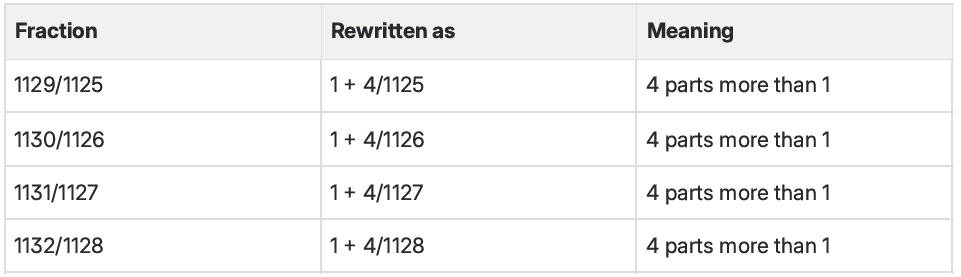
Each of these fractions is slightly greater than 1. A useful way to compare them is to rewrite
them as:
Since all four fractions are 1 plus something, students need to compare 4/1125, 4/1126, 4/1127
and 4/1128. When the numerator is the same, the fraction with the smaller denominator is larger.
Therefore, 4/1125 is the largest of these parts, making 1129/1125 the largest number.
What is the Most Common Wrong Answer and Possible Misconception?
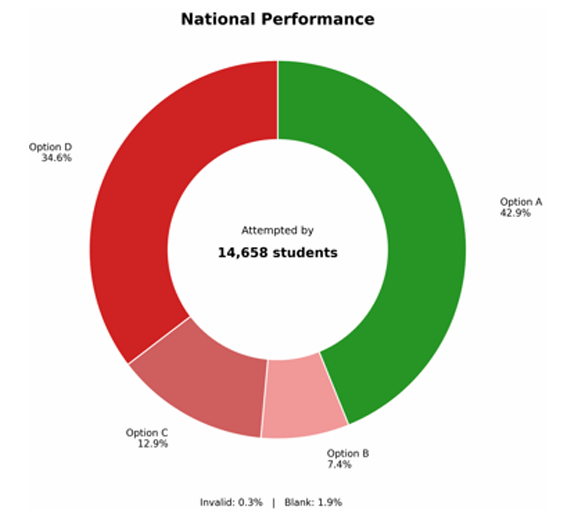
Most Common Wrong Answer: Option D
Percentage of Students Choosing Option D: 34.6%
Distractor Explanation
Option D: 1132/1128
Error Type: Comparing only the visible size of the numerator or denominator. Reasoning: Students choosing this option may have noticed that 1132 is the largest numerator
and 1128 is also the largest denominator. They may have assumed that the fraction with the
largest-looking numbers must be the largest fraction. Possible Misconception: These students may not yet understand that a fractionʼs value
depends on the relationship between the numerator and denominator, not on the size of either
number alone. In this case, all fractions are close to 1, and the deciding factor is the small extra
part above 1. Options B and C
Students choosing Options B or C may not have a stable method for comparing rational
numbers when both numerator and denominator change. Some may be applying an incomplete
rule, while others may be estimating without checking the actual relationship between the
numbers.
What Will Happen if Children Do Not Develop This Concept Adequately?
If students do not develop this understanding, they may continue to treat a fraction as two
separate whole numbers instead of one single value. For example, they may think 1132/1128 is
the largest fraction simply because 1132 and 1128 are the largest numbers shown.
This can create deeper difficulties later in mathematics:
Weak fraction sense: Students may struggle to judge whether a fraction is close to 0, close to 1, or greater than 1. This affects estimation and comparison.
Difficulty with rational numbers: Later topics such as equivalent fractions, decimals,
percentages, ratios, rates and algebraic fractions all require students to understand the
relationship between the numerator and denominator.
Overuse of mechanical methods: Students may rely on procedures such as cross
multiplication without understanding why they work. This becomes risky when numbers are
large, close together, or presented in unfamiliar ways.
Poor mathematical judgement:In real mathematical thinking, students need to ask: “What is
this number close to?” Here, all four options are close to 1. The key idea is not which
numerator is largest, but which fraction is slightly more than 1 by the greatest amount.
A useful teacher takeaway is this Before teaching students to compare fractions by procedure, first strengthen their ability to
locate fractions mentally: less than 1, equal to 1, just above 1, or much greater than 1.
How Should I Remediate This in My Class? 1. Start with the question: How far from 1?
Instead of beginning with cross-multiplication, ask students to rewrite each fraction as:
Then ask: All of them are 1 plus 4 parts. So which 4 parts are bigger: 4/1125 or 4/1128?
This helps students see that when the numerator is the same, the fraction with the smaller denominator is larger.
2. Use a simple visual
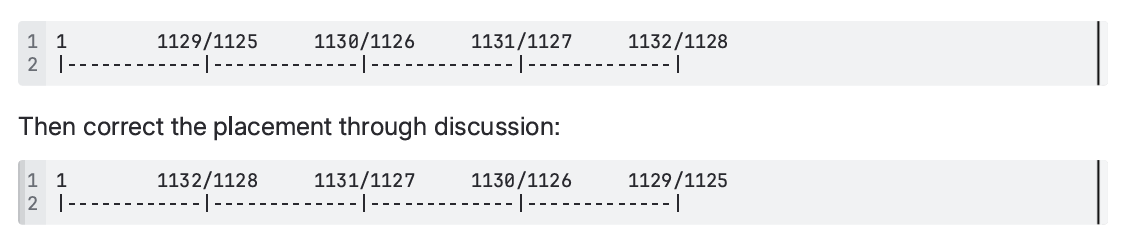
A useful visual for this question is a number line close to 1.
You can show students that all four fractions are just to the right of 1:
The exact distances are tiny, but the idea matters: 1129/1125 is farthest from 1 because 4/1125 is the largest extra part.
3. Give students smaller parallel examples first
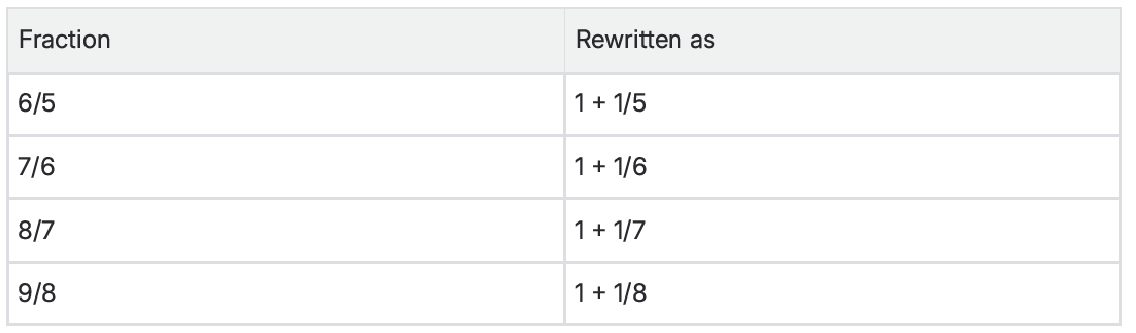
Before using large numbers, use simpler examples with the same structure:
Ask students:
Which is largest? Why?
Many students may initially choose 9/8 because 9 and 8 are the largest visible numbers. This
creates a useful classroom discussion. Students can then see that:
6/5 = 1 + 1/5
9/8 = 1 + 1/8
Since 1/5 is greater than 1/8, 6/5 is greater than 9/8.
This smaller example prepares them to understand the original question
4. Address the Option D misconception directly
Write this on the board:
Student A says: “Option D must be correct because 1132 is the biggest numerator.”
Ask the class:
Is this reasoning always true?
Can a fraction with a smaller numerator be larger?
What matters more: the size of the numerator alone, or the relationship between numerator
and denominator?
Then give a quick counterexample:
Although 100 is much larger than 5, 5/2 is the larger fraction.
This helps students break the misconception that ‘bigger-looking numbers mean bigger
fractionsʼ.
5. Use an exit ticket
At the end of the lesson, give this short check:
Which is larger: 15/14 or 18/17? Explain without cross-multiplying.
Expected reasoning:
15/14 = 1 + 1/14
18/17 = 1 + 1/17
Since 1/14 is greater than 1/17, 15/14 is larger
This checks whether students have understood the idea conceptually, not just followed a
procedure.