Words like ‘problem-solving’, ‘critical thinking’, and ‘creativity’ have become buzzwords
amongst educators. The New National Education Policy (NEP, 2020) defines these skills as
competencies of higher-order cognitive thinking, adding ‘analytical skillsʼ as an additional piece.
The policy also emphasised competency-based assessments which brought more attention to
these skills. Schools started rushing to train teachers on how these 21st-century skills can be
developed amongst students — through improving teaching practices, designing better
assessments, and more. The desperation to build competencies has been palpable in the last
five years, and for good reason.
Problem-solving is a relevant, real-life skill
The ability to solve problems is not just an academic requirement. Research evidence strongly
supports that problem-solving is consistently highlighted as a top predictor of workforce
success (Oliveri, Lawless, & Molloy, 2017; Kanfer & Blivin, 2019). In fact, when compared to
other skills, problem-solving emerges as a ‘necessary generic skillʼ across professions (OʼNeil,
2004).
For a skill that is important for life-long success, it is concerning that our students consistently
fail to demonstrate this competency when it is measured. Data from large-scale assessments
like ASER and the National Achievement Survey (NAS) points to a persistent gap between what
students can recall and what they can actually apply. Performance on Ei ASSETʼs questions that
require problem-solving skills also paints a similar picture: these are usually low-performing
items with around 30% or below of test-takers selecting the correct answer.
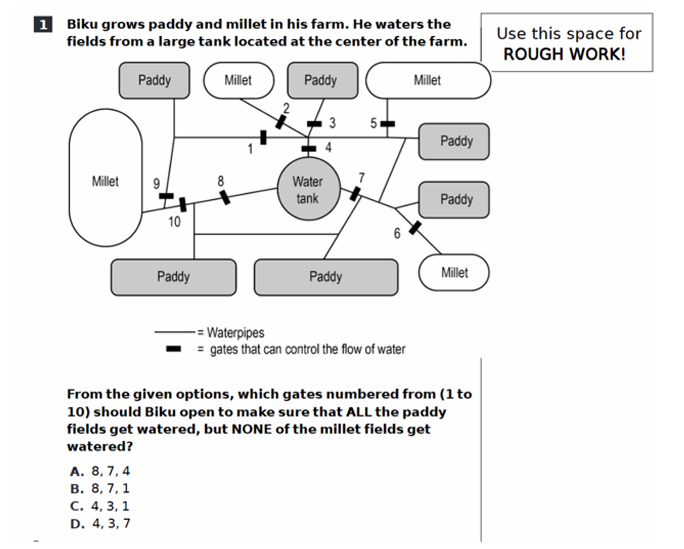
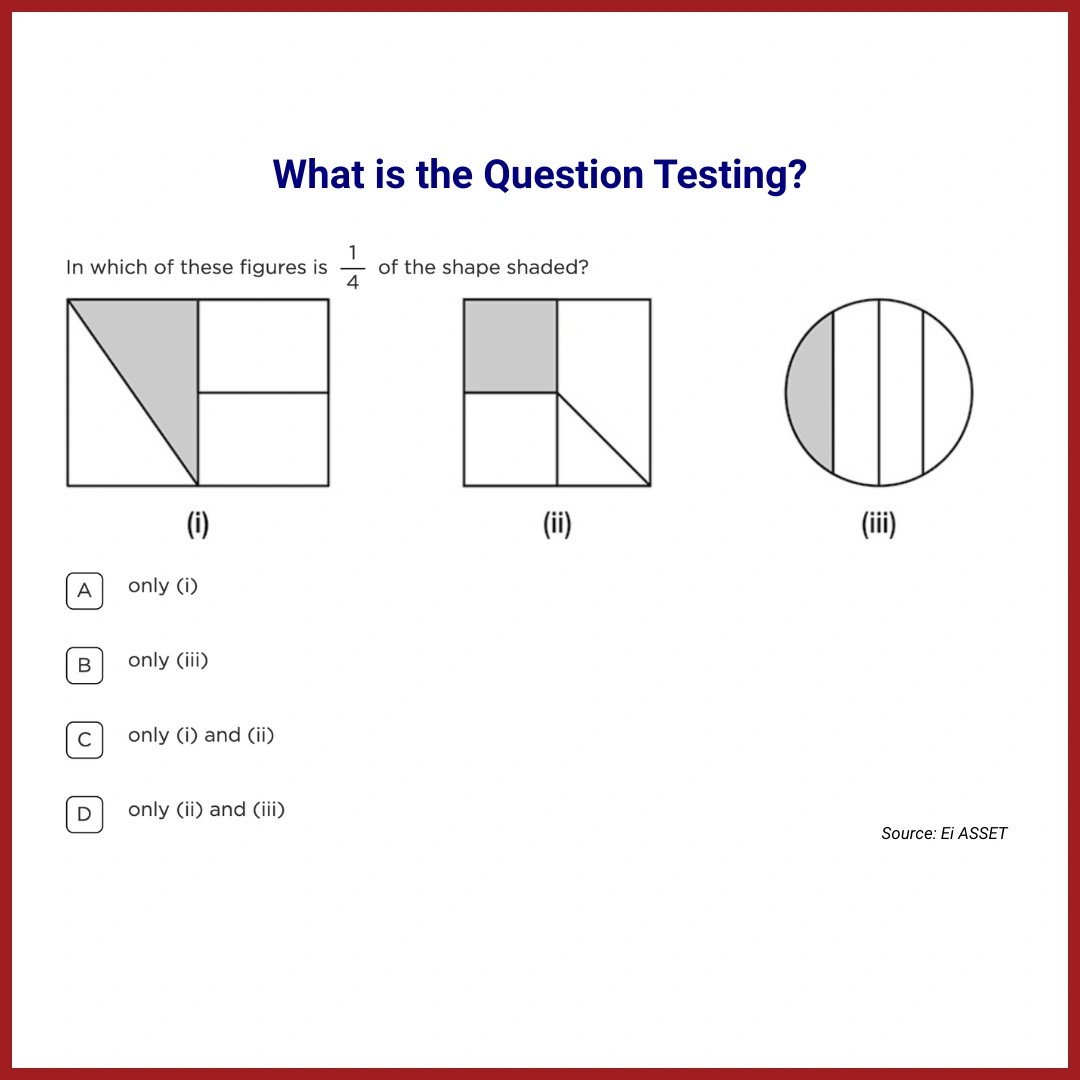
The following question was attempted by around 2,000 7th and 8th graders in the Summer
2024 Round as part of the Ei ASSET Artificial Intelligence & Digital Thinking (AI & DT) paper.
The question tests students’ ability to solve a problem using logical deduction and visualisation.
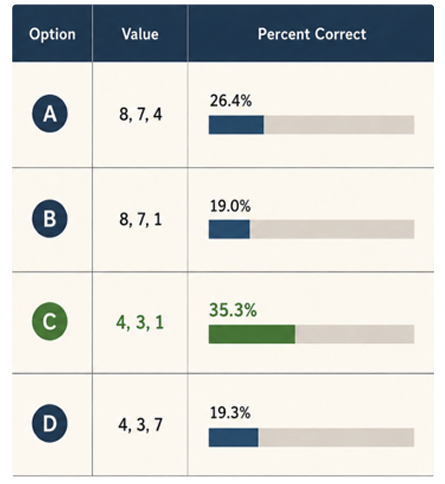
The performance data on the item is as follows. Option C is the correct answer as it fulfils both
conditions: ALL the paddy fields get watered, and NONE of the millet fields get watered. Only
26.4% of students were able to answer this correctly
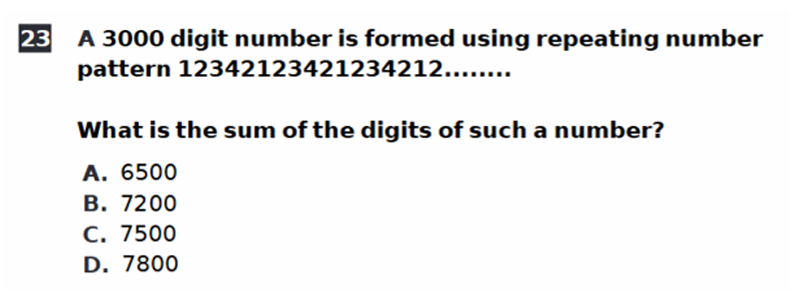
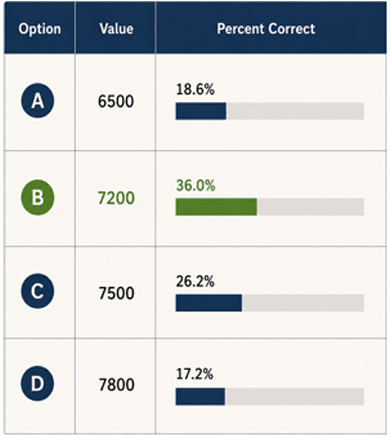
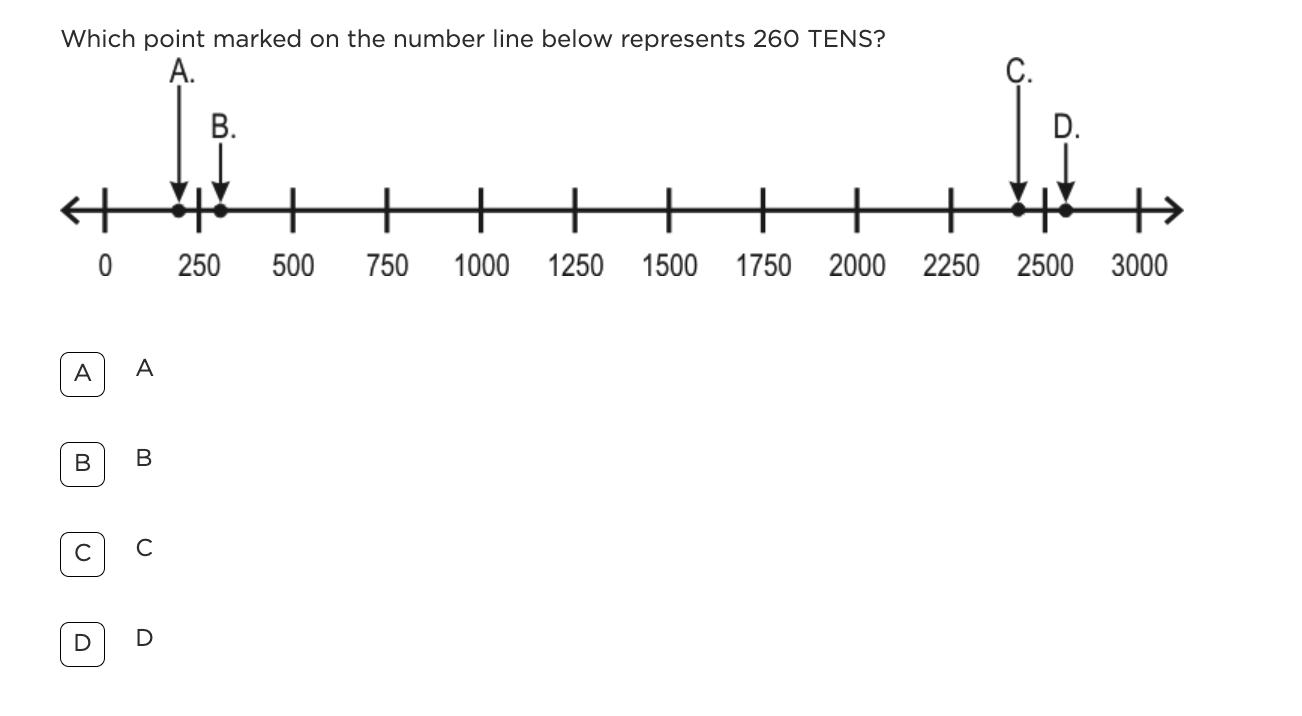
Another question asked in Ei ASSET Maths for grade 8 shows similar performance for problem
solving. Answering the question requires algorithmic thinking by combining pattern recognition
with mathematical concepts such as division and multiplication
The correct answer is option B: 7200. If one is able to recognise that 5 digits form a pattern,
divide that by 3000 and multiply the sum of the 5 numbers by this result, they would arrive at
the answer. Around 16,000 students attempted this item, of which, only 36% were able to
answer this correctly.
A third example comes from ASSET English, 2024. The following infographic was used as a
reading comprehension passage in grade 8, with items geared to test comprehension of data,
text, and graphical elements.
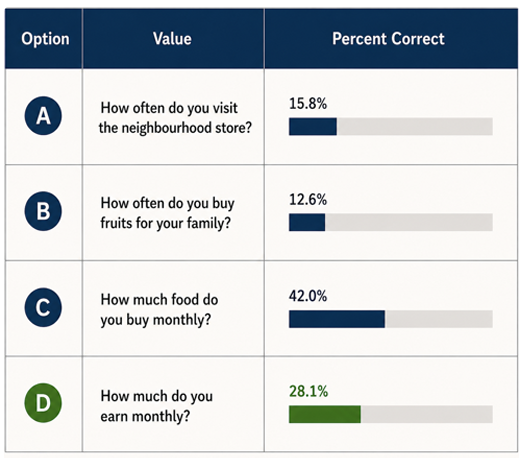
The following question requires students to work backwards from the summary of the data.
They would need to comprehend the results and apply logical deduction to match the survey
question with its result
The correct answer is option D. If students were able to connect the information categorising
the richest and the poorest households in the passage to the fact that income details would be
required for it, they would have arrived at the correct answer. Only 28.1% of about 15,000
students answered this question correctly.
The pattern of low performance holds across subjects. When questions that require applying
knowledge to an unfamiliar situation are presented, students fail to demonstrate the ability to
problem-solve
Whatʼs the missing piece?
The results are not for a lack of effort. Many schools report trying different approaches to
address this—asking more ‘why’ and ‘how’ questions, encouraging discussion, attempting
project-based tasks. Pedagogically sound methods are being employed to encourage problem
solving. But do they simulate tasks that actually require problem-solving to execute? This is
the metric against which such pedagogical techniques must be judged.
For instance, the problem with ‘why’ and ‘how’ questions is that they do not automatically
demand reasoning. Often, they still tap into direct recall. For instance, a student who has been
told why the French Revolution happened can answer a ‘why’ question without reasoning
through anything. But if a student is asked a hypothetical question, such as, ‘If event X did not
happen, would the French Revolution still have happened?ʼ, problem-solving is required as the
student would have to run through the series of cause-and-effect to determine which factor
may or may not give a particular result.
Project-based tasks also do not ellicit problem-solving if they merely require a reproduction of
what has been taught. For instance, a model of the earthʼs rotation which is battery operated
and actually spinning may be eye-catching and engaging. But the student is likely not learning
anything new about problem-solving or using problem-solving skills to reproduce this scientific
fact. But if a student is asked to build a model to demonstrate why day and night occurs on
Earth, that would require visualising the phenomenon and representing it. The model would also
help students understand why day and night occurs on Earth (thereby dispelling certain
misconceptions related to the scientific phenomenon).
Discussions have shown to be effective in building problem-solving skills as well, particularly in
word problems in math (Koehler, Ertmer, & Newby, 2019). However, the quality of the discussion
matters more than the act of discussion itself. Often, only a handful of students participate in
discussions, and these are students who may already be high-performers. In other cases, the
discussion point might be too vague for students to engage in meaningful discourse. For
instance, students might be asked ‘What do we know about the poet?ʼ without any clear
indication of the expected response. Students might produce a variety of responses, mostly
embedded in direct recall. Another factor that impacts discussions is how well it is facilitated. If
the teacher allows for surface-level responses without probing for deeper engagement, the
student is not guided to use higher-order thinking skills. Often the onus of the discussion is left
on the student, when faciliation (involving active listening, paraphrasing, clarification and
correction, and asking followup questions) is an active role.
So the heart of the problem may not be our methods; it may be in how we are employing
them.
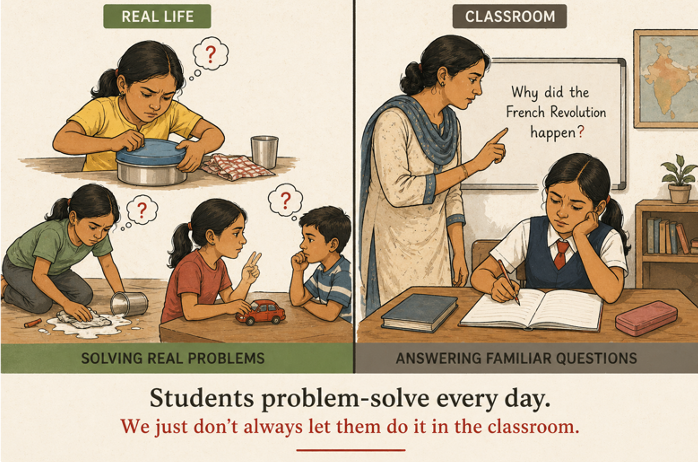
And yet, outside the classroom, students problem-solve all the time. Problem-solving is a skill
that comes naturally to human beings. It is at play when we heat a dish in the microwave with
the lid on, and find the lid stuck to the dish with the force of a vacuum seal. Using a sharp object
to release the pressure or re-heating the container to reverse the vacuum effect shows the
ability to problem-solve. Daily tasks like using an abosrbent towel to clean up liquid spills, or
resolving conflicts with loved ones, or even structuring a time table to better manage all the
homework, play, and miscellaneous tasks weʼd like to do in a day—they all simulate problem
solving.
It is when we try to develop problem-solving as a competency in academic settings that it
seems complex. Research shows that when real-life tasks are incorporated into classroom
lessons and discussions, students naturally employ their true ability to solve problems while
being open to learning new ways of solving problems as well (Gibson, 2009). Instead of setting
aside lessons to teach problem-solving, we give students the opportunity to solve problems,
and in the pursuit of doing so, naturally have them apply the skills and the thinking required to
demonstrate the competency. The competency becomes a byproduct of the method, not a target in itself
But what does problem-solving really entail? Is it the ability to think critically, or does it require
creativity? Is it different from analytical thinking? Since these buzzwords are often used
together, understanding the basic construct can provide a solid foundation for creating problem
solving opportunities in the classroom
Problem-solving as a theoretical construct
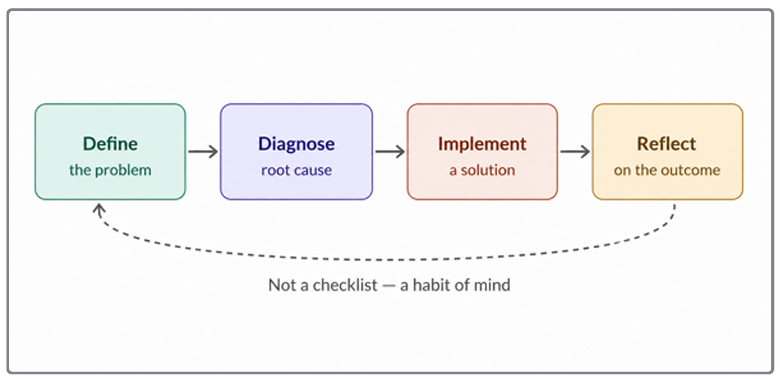
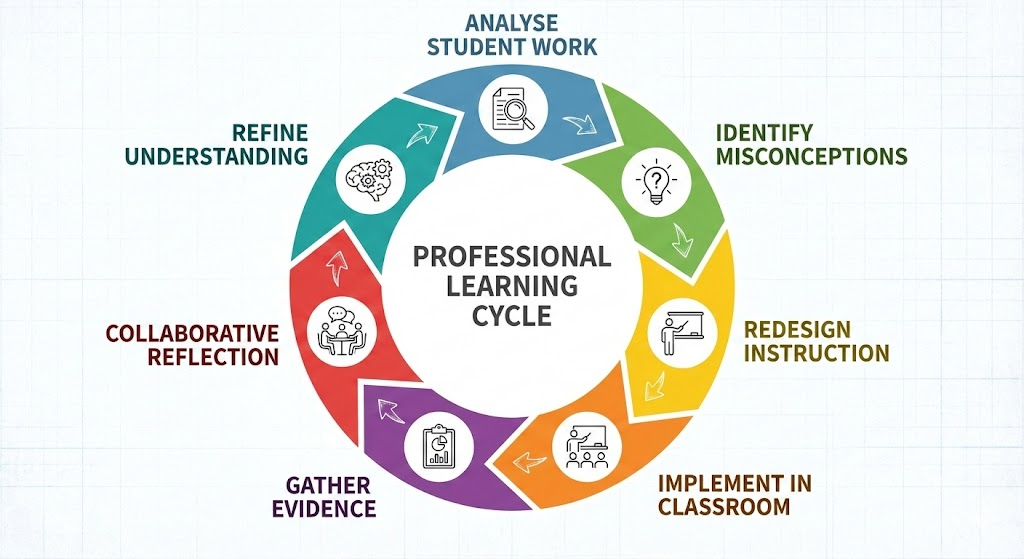
George Pólya, whose work on mathematical problem-solving has been foundational to
education research, described it as a structured process of understanding, devising, executing,
and reflecting. More broadly, problem-solving can be understood as a systematic, higher-order
cognitive process of defining a problem, diagnosing its root cause, and implementing an
effective, sustainable solution to achieve a desired outcome — followed by a reflection on what
worked and what didn’t
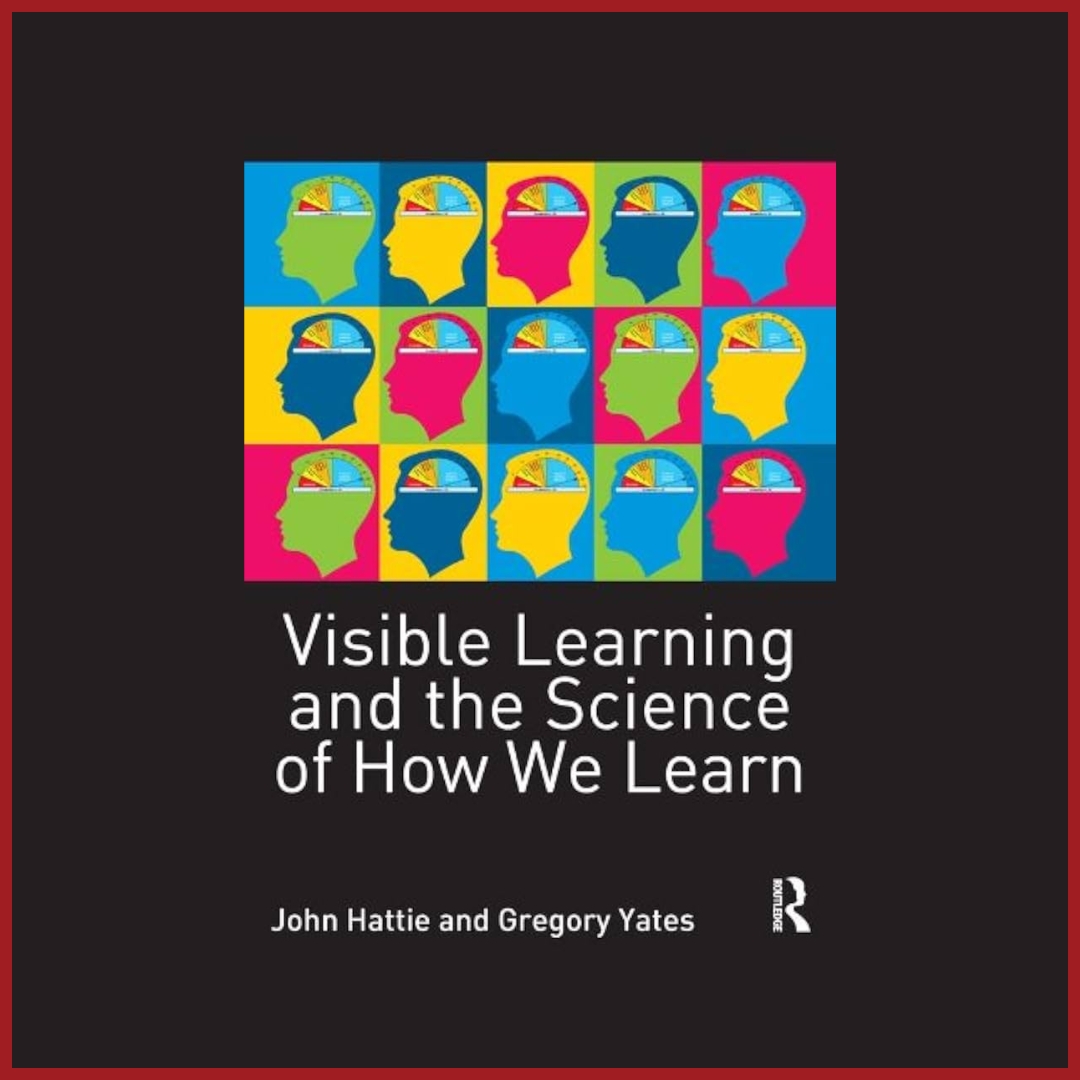
John Hattie’s meta-analysis (Visible Learning, 2009) found that metacognitive strategies—the
act of thinking about one’s own thinking—have among the highest effect sizes on student
achievement. Problem-solving, done well, is inherently metacognitive. Students who are trying
to solve a genuine problem have to monitor their own understanding, identify where they’re
stuck, and make decisions about how to proceed. This is not incidental; it is the mechanism
through which deep learning happens.
Any task that requires problem-solving will have these four components. If a student has to
engage in any one of these four components, the activity or question is naturally shaping the
competence of problem-solving.
Therefore, beyond pedagogical techniques discussed previously, what are some practical
ways that we can bring problem-solving into the classroom?
As a teacher, pretend to struggle with a question or task that requires students to solve the
problem for you. When you do so, you authentically model metacognition – an aspect important
for problem-solving. Pause while solving a sum on the blackboard asking student, ‘Wait, what is
the question asking?ʼ or ‘Hmm, am I doing this right?ʼ, or pause at a moment in the story asking,
‘I wonder why the author has written this line hereʼ, or pause at the textbook explanation of a
scientific concept paraphrasing the words and asking students if your paraphrase is correct.
This method is backed by Collins, Brown, and Newman’s work on cognitive apprenticeship
(1989), which shows that making expert thinking visible — including its false starts — is one of
the most effective instructional strategies available.
Pick up everyday issues and apply the problem-solving framework together as a class. A
broken classroom procedure, an unfair distribution of resources, a scheduling conflict—any of
these can become material. Students engage differently when the problem has stakes they
recognise. For instance, there is a lot of crowding and chaos near the tiffin boxes during the
lunch break. After having defined the issue, the class must diagnose the ‘root causeʼ of this
disruption. Is it because students there is no clearly defined procedure to collect oneʼs tiffin
boxes? Is it because all students go to collect their boxes at the same time? After brainstorming
on the causes, the class might want to pursue a cause and design a solution that addresses that
single cause. If students believe it is because all students go to collect their tiffin, a solution
might be having a tiffin monitor who ensures students collect their tiffins one-by-one. After
having implemented the solution for a week, the class might want to reflect on whether the
problem has been resolved. If not, is the problem in the implementation or the solution itself?
Should the monitor be doing a better job, or should the teacher define a clear procedure? This
closes a cycle of problem-solving.
Create spaces for reflecting on ‘what workedʼ and ‘what didnʼt work’ in the classroom.
Group activities or peer activities should not end on the task, but a reflection on the process.
Ask students to share what they thought worked and what did not work in the group activity. If
students are unable to produce specific responses on this, you can guide them by posing follow
up questions: ‘What is one thing that was ‘not niceʼ about the activity?ʼ, or ‘If you had to design
this, what would you do differently?ʼ Such guiding questions help students engage in
metacognition, an aspect that directly feeds into problem-solving.
Presenting scenario-based questions rather than direct or isolated ones. Instead of asking
students to calculate area, present a situation: ‘The school wants to tile its library floor on a
limited budget. Which tile size is most cost-effective?ʼ Embed exercises and sums in everyday,
authentic scenarios that require problem-solving. You can get inspiration from Ei ASSET
questions if the curriculum does not provide this support. Discuss the question in the class and
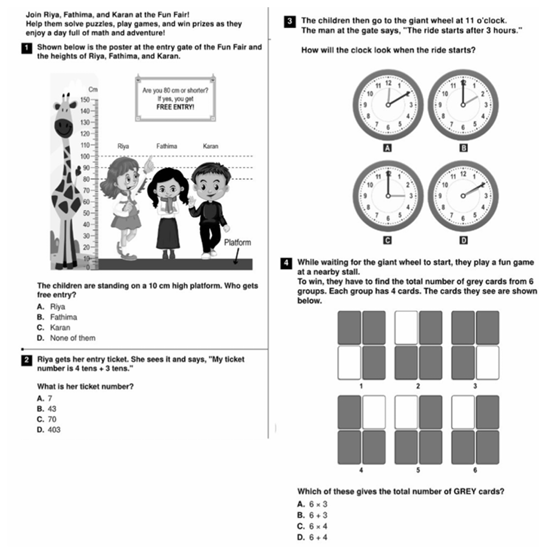
solve it together. For instance, the grade 3 ASSET Maths paper of 2025 is a theme-based paper
that uses the context of three friends having to use mathematical concepts to solve the various
problems they encounter as they enjoy a day the Fun Fair.
Such questions may help you as an educator also reframe what classifies as a problem for
students to solve. Such questions are also engaging for students as they are not contrived or
artificial tasks that students ‘have to doʼ, but problems that they feel excited to solve. Grade 3
students reported that they liked the paper and enjoyed solving it. Such assessments stop
feeling like an exam while testing competencies like problem-solving.
Make problem-solving the default mode for your students, rather than a competency to be built
through specific subjects, lessons, or even pedagogical techniques. When we reframe how we
thinking about ‘problem-solvingʼ as educators, we might start seeing shifts in how our students
demonstrate them.