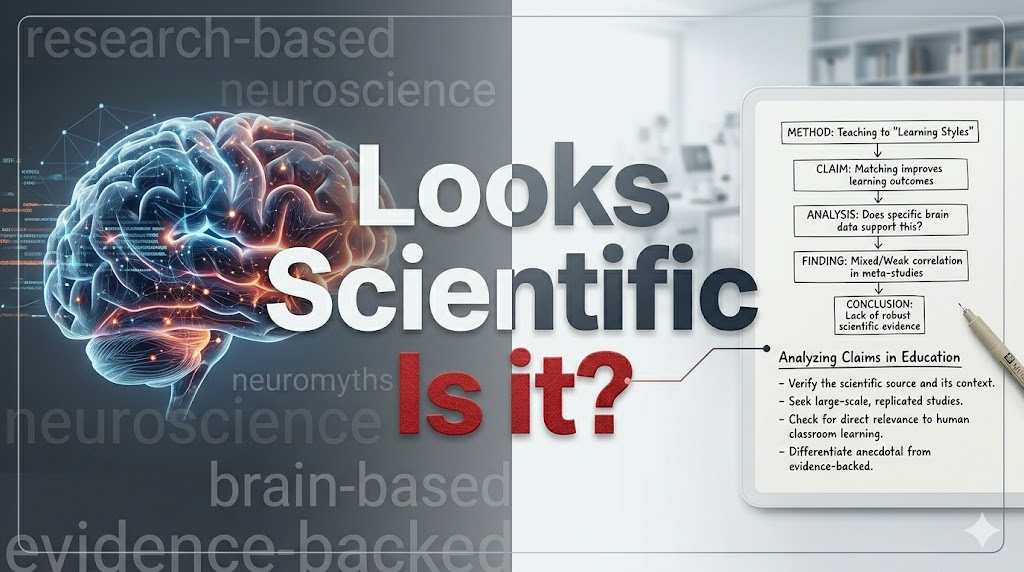
Across education, the term research-based is frequently used to signal quality. Teaching strategies, programmes, and interventions are often justified using this label. However, research in cognitive psychology and education suggests that people do not always evaluate evidence carefully. Instead, they are influenced by how that evidence is presented.
A number of experimental studies, including work on the seductive allure of neuroscience and related research on judgement and reasoning, have shown that explanations are often rated as more convincing when they include scientific language, references, or technical detail, even when these additions do not improve the explanation itself.
More broadly, analyses of how educators and decision-makers interpret research have highlighted a recurring pattern: labels such as ‘research-based’ or ‘evidence-backed’ can act as shortcuts for credibility, even when the underlying evidence is limited, misinterpreted, or only partially relevant to classroom contexts.
The key issue is not the presence of research, but the quality, interpretation, and applicability of that research.
The Main Findings
The label research-based increases perceived credibility, even when evidence is weak or incomplete.
People often rely on surface signals such as terminology, references, and authority rather than evaluating the strength of the evidence itself.
Explanations that feel clear and intuitive are frequently judged as more convincing than those that are more accurate but less familiar.
Under time pressure, even experienced educators may rely on these shortcuts.
Strong educational research is often conditional and context-dependent, but is sometimes presented as universally applicable.
In short: What sounds evidence-informed is not always what is strongly evidenced.
Related Research
Several well-established ideas from cognitive science help explain why this happens.
Cognitive fluency Information that is easy to process or sounds familiar is more likely to be judged as true. Clear, confident, and technical explanations can therefore feel more valid, even when they are not.
Illusion of explanatory depth People often believe they understand an idea more deeply than they actually do. References to research can reinforce this illusion, creating a sense of understanding without real clarity.
Seductive details Interesting but irrelevant information can make explanations seem richer while distracting from the core idea. In educational contexts, references to research can sometimes function in this way if they are not tightly connected to classroom practice.
Confirmation bias People are more likely to accept ideas that align with their existing beliefs. In education, intuitive ideas can persist even when evidence is mixed or weak.
Together, these findings suggest that evaluating educational claims requires more than recognising the presence of research. It requires examining how that research is used.
Classroom Implications
For teachers, the implication is not to distrust research, but to engage with it more carefully.
In practice:
Do not treat research-based as a guarantee of quality.
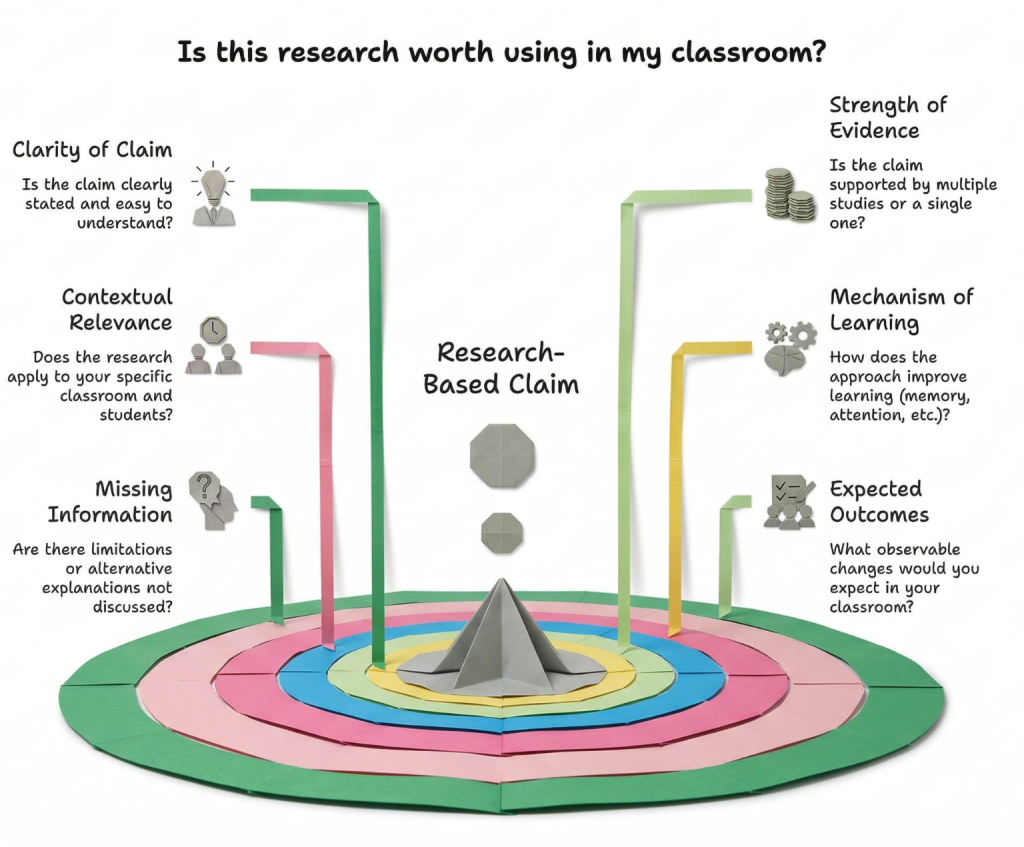
Look for clarity about what the research actually shows, and under what conditions.
Ask whether the claim is supported by multiple studies or a narrow evidence base.
Be cautious of approaches presented as universally effective across all learners and contexts.
Focus on whether the idea improves understanding, retention, and transfer, not just engagement or activity.
A useful professional question is: What is the mechanism by which this improves learning?
If that cannot be clearly explained, the claim may be weaker than it appears.
Final Reflection
Research can strengthen teaching, but only when it is interpreted with care.
For educators, the goal is not to adopt every research-labelled idea, but to develop the ability to question, interpret, and apply evidence thoughtfully.
The real test is simple: Does this idea improve how students think and learn, or does it only sound convincing?
Reference
Weisberg, D. S., Keil, F. C., Goodstein, J., Rawson, E., and Gray, J. R. (2008). The seductive allure of neuroscience explanations. Journal of Cognitive Neuroscience, 20(3), 470–477.
Conceptual grounding also draws on established findings in cognitive science related to fluency, judgement, and learning.