No. of students who attempted this question- 23,468
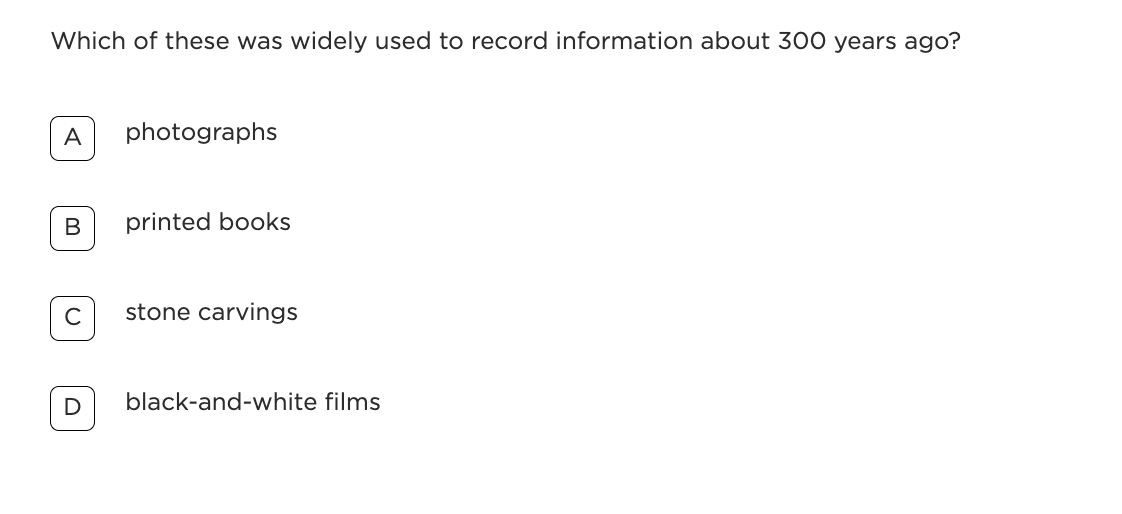
Source: Ei ASSET, Social Studies- Class 6 Correct Answer: B Skill Tested: Knowledge and understanding of historical developments
What is the Question Testing?
This question assesses students’ understanding of technological developments in methods of recording and sharing information across historical periods. Specifically, it checks whether students recognise that printed books were widely used around 300 years ago, after the spread of printing technology.
Students who choose Option B demonstrate an understanding that printing had become an established method of recording and distributing knowledge by that time.
The question also requires students to distinguish between different stages in the history of communication technologies, recognising that some forms belong to much earlier periods while others emerged only much later.
What is the Most Common Wrong Answer and Possible Misconception?
Most Common Wrong Answer: Option C (Stone carvings) Percentage of Students Choosing Option C: 68.7%
A large number of students selected stone carvings, suggesting that they associate early methods of recording information with any time in the past without distinguishing ancient history from the more recent past.
These students likely recognise stone carvings as an early form of recording information but do not realise that by 300 years ago, printed books had already become the dominant method for storing and sharing written knowledge.
This indicates a difficulty in placing technologies accurately on a historical timeline.
Distractor Explanation :
Option C: Stone carvings Students choosing this option may correctly identify stone carvings as an ancient method of recording information. However, they overlook the time reference in the question. Stone carvings were widely used thousands of years ago, but by about 300 years ago, printing technology had already become the primary medium for recording and disseminating information.
Option A: Photographs Students choosing this option may not realise that photography was developed much later, in the nineteenth century. Photographs therefore could not have been widely used 300 years ago.
Option D: Black-and-white films Students selecting this option likely associate older technologies with earlier time periods but may not know that film technology emerged in the late nineteenth and early twentieth centuries.
Consequences of Children Not Developing This Concept
Weak historical timeline understanding: Students may struggle to correctly place events, inventions, and developments in chronological order.
Difficulty connecting technological change with social history: Understanding when technologies emerged is important for explaining how societies stored knowledge, communicated ideas, and shared information.
Limited contextual understanding in social science learning: Without a clear sense of technological progression, students may find it harder to interpret historical sources and developments accurately.
How Should I Remediate This in My Class?
Build Historical Timelines
Create a simple classroom timeline of major communication technologies such as stone inscriptions, handwritten manuscripts, printing presses, photography, and film.
Ask students to place each method in the correct historical period.
Compare Technologies Across Time
Show images of different recording methods and ask students to discuss which might have been used earlier or later and why.
Encourage them to think about how technological changes made it easier to record and share information.
Connect Technology with Historical Context
Discuss how the invention and spread of printing made books more widely available and helped spread ideas across societies.
Use Visual Sources
Show examples of inscriptions, early printed books, and photographs to help students visualise how methods of recording information evolved over time.
Teacher Takeaway
Students often recognise older technologies but may not accurately place them within a historical timeline. Explicit teaching of technological progression in communication and record-keeping helps students better understand how societies preserved and transmitted knowledge across different periods.