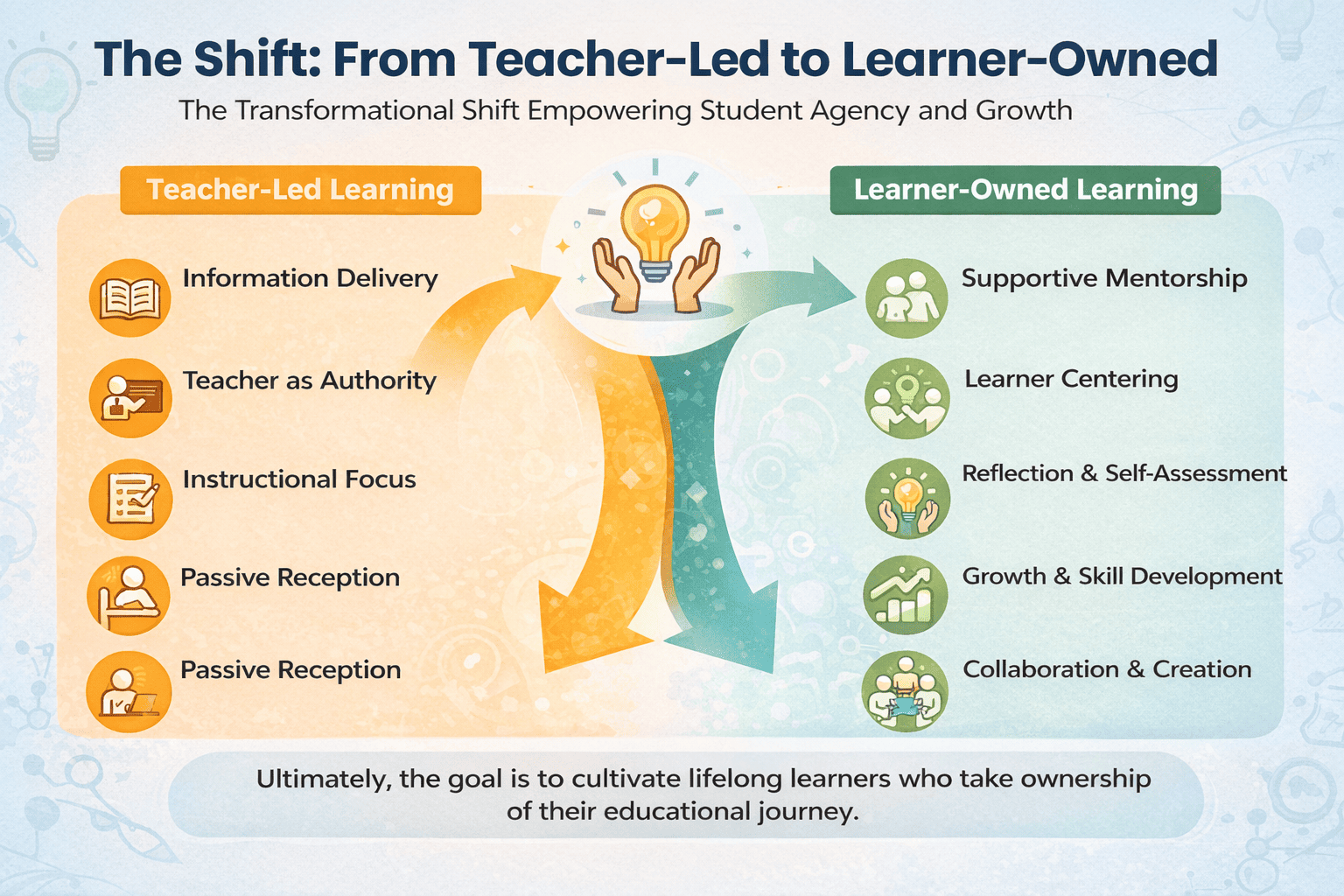
The Shift: From Teacher-Led to Learner-Owned
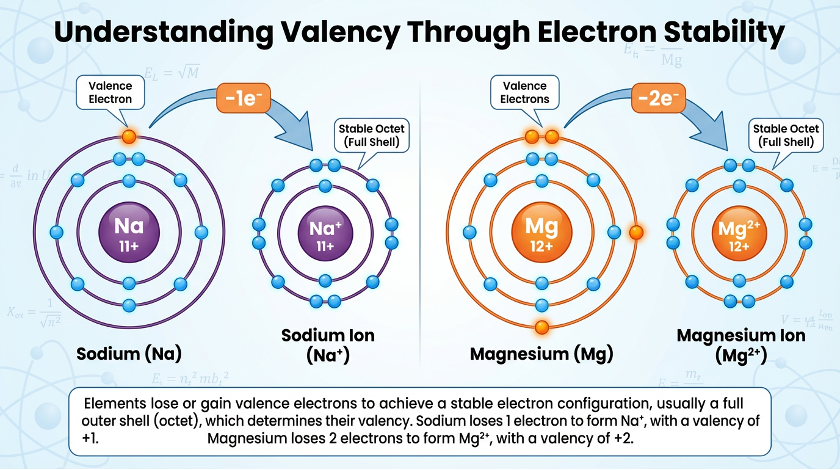
Consider the earlier classroom moment when students explored atomic number and electronic configuration before learning valence. When sodium was written as 2,8,1 and magnesium as 2,8,2, students were not immediately told their valencies. Instead, they were asked:
Guiding Questions for Student Reflection:
| | Questions That can Shift Thinking |
|---|
| 1 | What pattern do you notice in the outermost shell? |
| 2 | Which atoms appear stable already? |
| 3 | What might sodium need to do to become stable? |
Some students explained stability through electron loss. Others simply linked valency to group number. That reflection pause revealed who truly understood and who was relying on surface patterns. At that moment, the responsibility subtly shifted. Instead of the teacher correcting and moving ahead, students analysed their own thinking. When later asked why magnesium forms MgCl₂ instead of MgCl, they reasoned through electron stability rather than applying a crossing rule.
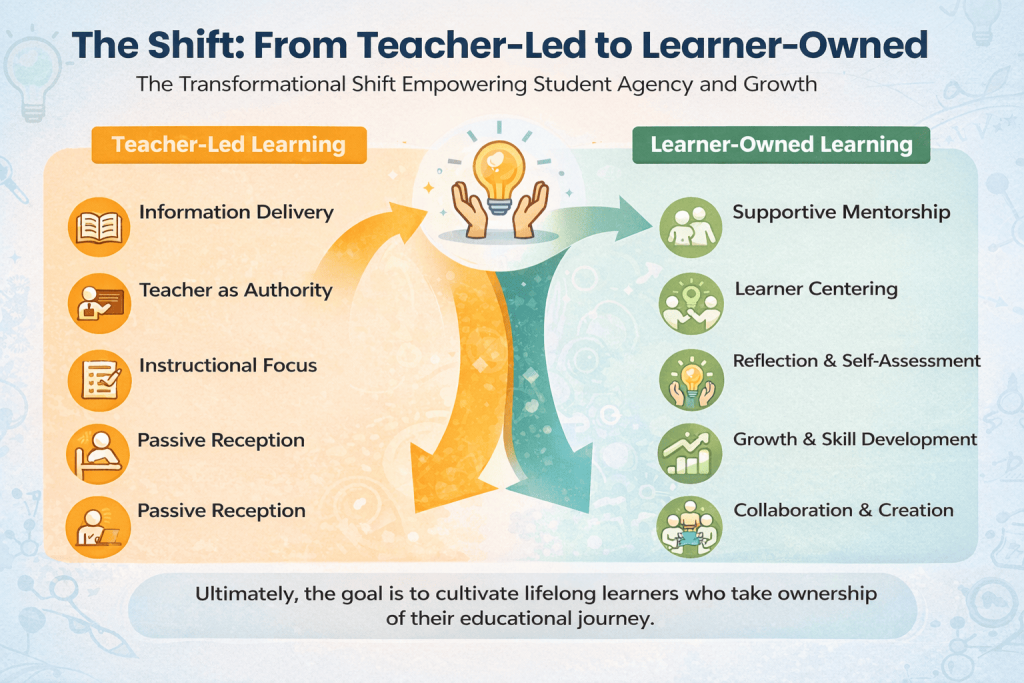
This is the shift.
We aim to build independent individuals, yet often the full weight of learning rests on the teacher. When structured reflection is embedded at key conceptual stages, students begin asking themselves:
Student Self-Questioning:
| | Few Critical Self-Reflection Questions |
|---|
| 1 | What do I understand about electron stability? |
| 2 | Where is my confusion? |
| 3 | What must I clarify before moving ahead? |
Here, the teacher becomes a facilitator of thinking, not just a provider of procedures. The learner becomes accountable for conceptual clarity. This shift demands patience. It requires allowing productive struggle and resisting the urge to supply immediate answers. But it builds ownership.
And ownership is what transforms classrooms from grade-focused spaces into growth-driven environments.
Reflection moves learning from:
What did the teacher teach?
to
What did I understand? What do I not yet understand? What will I do about it?
Here, the teacher becomes a facilitator. The learner becomes accountable.
This shift is demanding. It requires a lot of planning, patience, and reflection on the part of the teachers. It also demands that teachers take a backstep and allow productive struggle, withholding immediate correction and just being there for the students, leading them in the correct direction.
But it prepares students for life, not just exams.
Reflection Should Not Be an End Activity
If reflection happens only after the unit test, it is too late. Reflection must be embedded within the learning journey. This is the most crucial step. In the example stated above at the beginning of the text, if the gaps had been identified at a very early stage and closed by the learners, there would have been absolute clarity of the concept.
How Can This Be Practised in Class?
1. Mid-Lesson Concept Check Reflections
After teaching a key idea (e.g., valency and electron transfer), ask students:
| | Few Student Reflection Prompts |
|---|
| 1 | What is one thing I am confident about? |
| 2 | What still confuses me? |
| 3 | What example can I create on my own? |
This reveals gaps before the summative test.
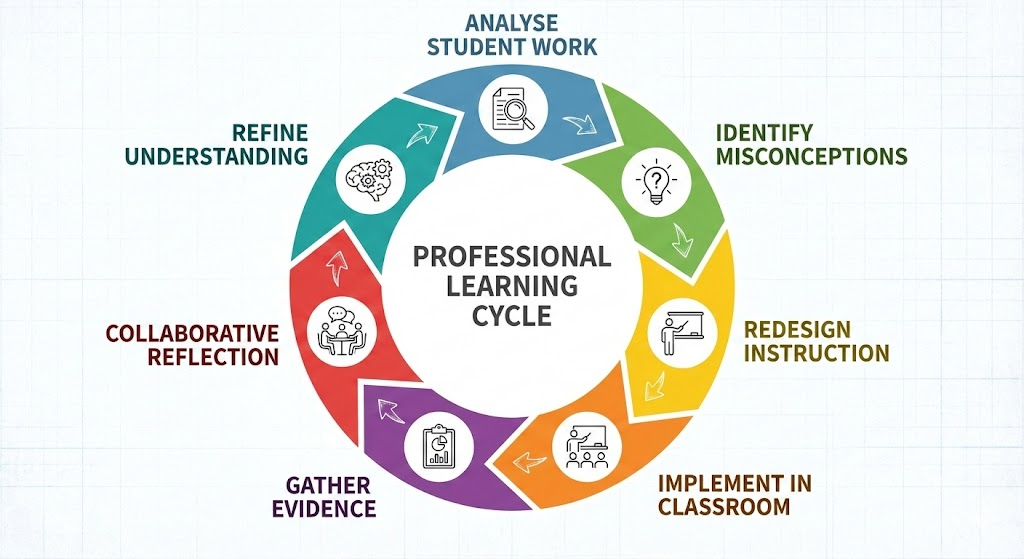
2. Misconception Analysis Routine
Present a common incorrect answer (e.g., MgCl instead of MgCl₂).
Ask:
| | |
|---|
| 1 | Why might someone think this is correct? |
| 2 | What assumption are they making? |
| 3 | What concept is missing? |
Students begin analysing thinking, not just answers.
3. Learning Journals Linked to Vertical Growth
At the end of a lesson, students write:
| | Few Journal Prompts for Vertical Learning |
|---|
| 1 | How will today’s learning help me next year? This process is also linked to the vertical mapping of the curriculum and identifying the power standards, which serve as an important aspect in building the concept. |
| 2 | Where might I use this concept again? |
This builds awareness of learning progression.
4. Error-to-Action Reflection
After any assessment:
| | Reflection-to-Action Framework |
|---|
| 1 | What mistake did I make? |
| 2 | Why did I make it? |
| 3 | What will I practise differently? |
Students then complete a short, targeted correction task to close the gap in learning.
When students learn to:
| 1 | Identify their misconceptions |
| 2 | Take responsibility to close gaps |
| 3 | Connect present learning to future application |
Vertical learning strengthens naturally.
Reforming education is not only about changing pedagogy. It is about cultivating learners who can think about their thinking and act on it. That is when independence truly begins.
The article is contributed by Ms. Anshika Saxena.
Instructional Coach, Science
Heritage International Xperiential School, Gurugram