Discover thought-provoking book recommendations tailored for educators. Each pick includes
a concise synopsis and actionable takeaways to inspire and enrich teaching practices.
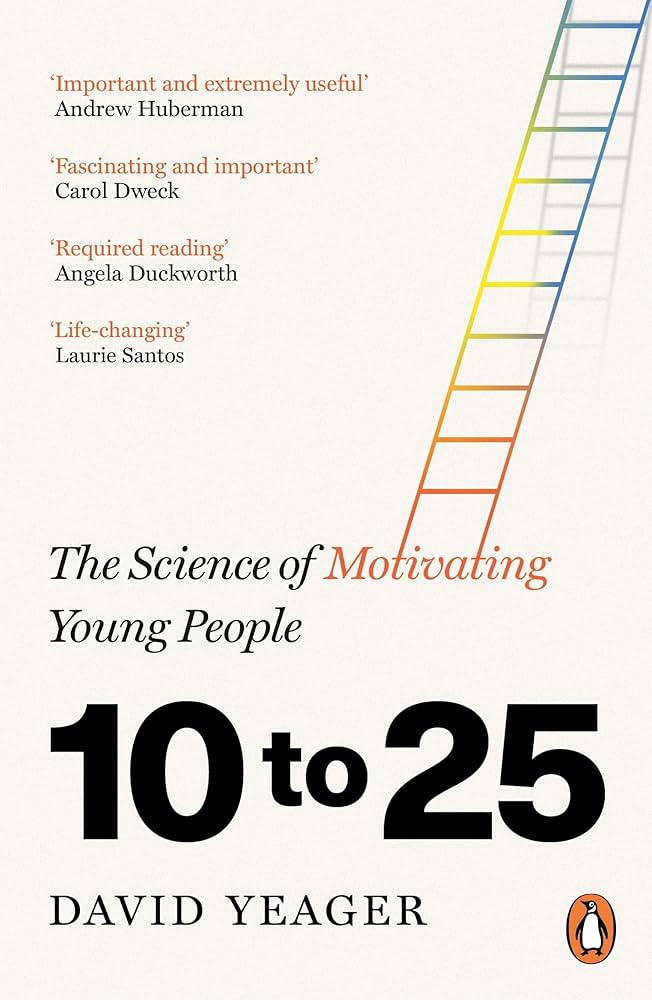
10 to 25: The Science of Motivating Young People by David S. Yeager brings together powerful insights from psychology, neuroscience, sociology, and education to explain what truly motivates adolescents. Yeager argues that young people are not unmotivated—they are motivated by the wrong cues when adults unknowingly create conditions that dampen curiosity, agency, or purpose.
Drawing on large-scale studies, longitudinal research, and interventions conducted in schools across the world, Yeager shows that teenagers thrive when three conditions are met: they feel respected, they feel capable, and they feel that what they are doing matters. When these psychological needs are met, motivation increases sharply; when they are undermined, even the most talented students disengage.
At its core, the book reframes motivation not as a character trait but as a developmental, context-sensitive process shaped by how adults relate to young people, especially between the ages of 10 and 25.
Why Teachers Will Find This Useful:
Understanding adolescent psychology
The book gives teachers a science-based explanation of why young people behave the way they do, why they resist control, why belonging matters so deeply, and why purpose drives sustained effort.
Practical classroom applications
Yeager translates abstract research into usable strategies: creating purposeful tasks, offering meaningful choices, using affirming language, and designing feedback that builds trust and competence.
A shift from compliance to agency
Instead of attempting to ‘manage behaviour’, teachers learn how to design learning environments that unlock intrinsic motivation, persistence, and prosocial behaviour.
Why We Recommend It:
This book is research-rich yet deeply human. Yeager writes with clarity, empathy, and rigour, offering teachers a lens to reinterpret student behaviour not as defiance or apathy but as signals of unmet psychological needs.
At a time when classrooms face rising disengagement, attention challenges, and emotional fatigue, 10 to 25 provides a clear, actionable framework to build environments where young people feel seen, supported, and inspired.
It is both reassuring because motivation can be grown and challengingbecause it asks adults to re-examine practices that unintentionally undermine it.
Interesting and Actionable Takeaways:
When young people feel respected rather than controlled, their motivation increases dramatically.
A sense of purpose connecting learning to something bigger than oneself is one of the strongest predictors of persistence.
Adolescents respond powerfully to high standards paired with assurance: “I’m asking you to do this because I know you can.”
Brief ‘wise interventions’- simple, scientifically designed messages can significantly boost motivation, belonging, and academic outcomes.
Motivation collapses when students feel judged; it strengthens when they feel that adults are on their side, not evaluating them.
Zoom-in Excerpts:
“Adolescents don’t need to be pushed harder. They need to believe that what they are doing matters and that the adults around them believe in their potential.”
Explanation:
This excerpt captures Yeager’s central insight: motivation is fundamentally relational. Young people rise to challenges when they sense that their goals have meaning and when adults communicate belief in their capacity. For teachers, this is a reminder that the tone we set our expectations, our feedback, our warmth, and our framing of tasks can either unlock or shut down motivation. By helping students connect their learning to purpose and potential, we create classrooms where effort becomes self-driven and growth becomes sustainable.